Physical Address
304 North Cardinal St.
Dorchester Center, MA 02124
Physical Address
304 North Cardinal St.
Dorchester Center, MA 02124

It started with a patio that was too hot to use between June and September. I live in a neighborhood where the sun beats down on the south-facing yard from noon until dusk, and a standard umbrella just left a small circle of shade that the heat still found its way around. I tried a pop-up canopy for a season — it blew over during a minor thunderstorm and spent the rest of summer with a bent leg. I needed something with walls that could breathe, a roof that did not trap heat, and enough space for a sofa set and a dining table under one cover. That is what sent me looking at enclosed gazebos, specifically the 12-by-24-foot size that would turn the full width of my patio into usable room. The PURPLE LEAF gazebo review that follows is based on three weeks of real use in that yard, across temperatures from 78 to 102 degrees Fahrenheit, and through two rainstorms that tested its water resistance. I ordered the PURPLE LEAF Sunroom Solarium Screened Gazebo 12′ x 24′ from Amazon, assembled it with one helper, and have been using it daily since. This PURPLE LEAF gazebo review and rating covers what it does well, where it falls short, and whether the asking price of $5,599 makes sense for someone looking to reclaim their outdoor space.
Transparency note: This review contains affiliate links. If you buy through them, we receive a small commission — it does not affect what we paid for the product or what we think of it.
At a Glance: PURPLE LEAF Sunroom Solarium Screened Gazebo 12′ x 24′
| Tested for | Three weeks in a suburban backyard with direct afternoon sun, two rainstorms, and daytime highs of 78–102°F. |
| Price at review | $5,599 USD |
| Best suited for | Homeowners with a large patio or deck who want a semi-enclosed space that works in hot weather and can be sealed for cooler evenings or light rain. |
| Not suited for | Anyone expecting a four-season room that can handle heavy snow loads, freezing temperatures, or high winds without additional reinforcements. |
| Strongest point | The double roof design and mesh panel system keep the interior noticeably cooler than the ambient temperature—measured a 7–9°F difference on the hottest days. |
| Biggest limitation | Assembly is grueling—two people spent about 18 hours over two days, and the instructions gloss over several critical alignment steps. |
| Verdict | Worth buying for anyone who values daytime shade and evening enclosure, provided you have help to assemble it and you are comfortable with the price of a mid-range outdoor structure. |
The enclosed gazebo market has grown quickly over the last five years as more homeowners look for ways to extend their living space without the cost of a full sunroom addition. Most products under $3,000 are screened-only structures with fabric roofs that degrade after two seasons. Above $4,000 you enter the territory of hardtop aluminum frames, interchangeable panel systems, and dual-layer roofs. The PURPLE LEAF 12×24 sits squarely in the upper mid-range tier — not the most expensive (some motorized pergolas pass $10,000), but priced higher than the basic hardtop gazebos that measure 10×12 or 12×16. The brand itself has been active in outdoor structures for about six years, primarily through Amazon, and has built a reputation for decent fit and finish at competitive price points. A PURPLE LEAF hardtop gazebo review I wrote earlier highlighted similar assembly challenges but solid long-term durability. The key design choice here is the double roof — a solid top panel plus a ventilated upper layer — combined with removable tinted polycarbonate (PC) panels. That combination is not common at this price, and it directly addresses the problem of heat buildup that plagues many screened gazebos.
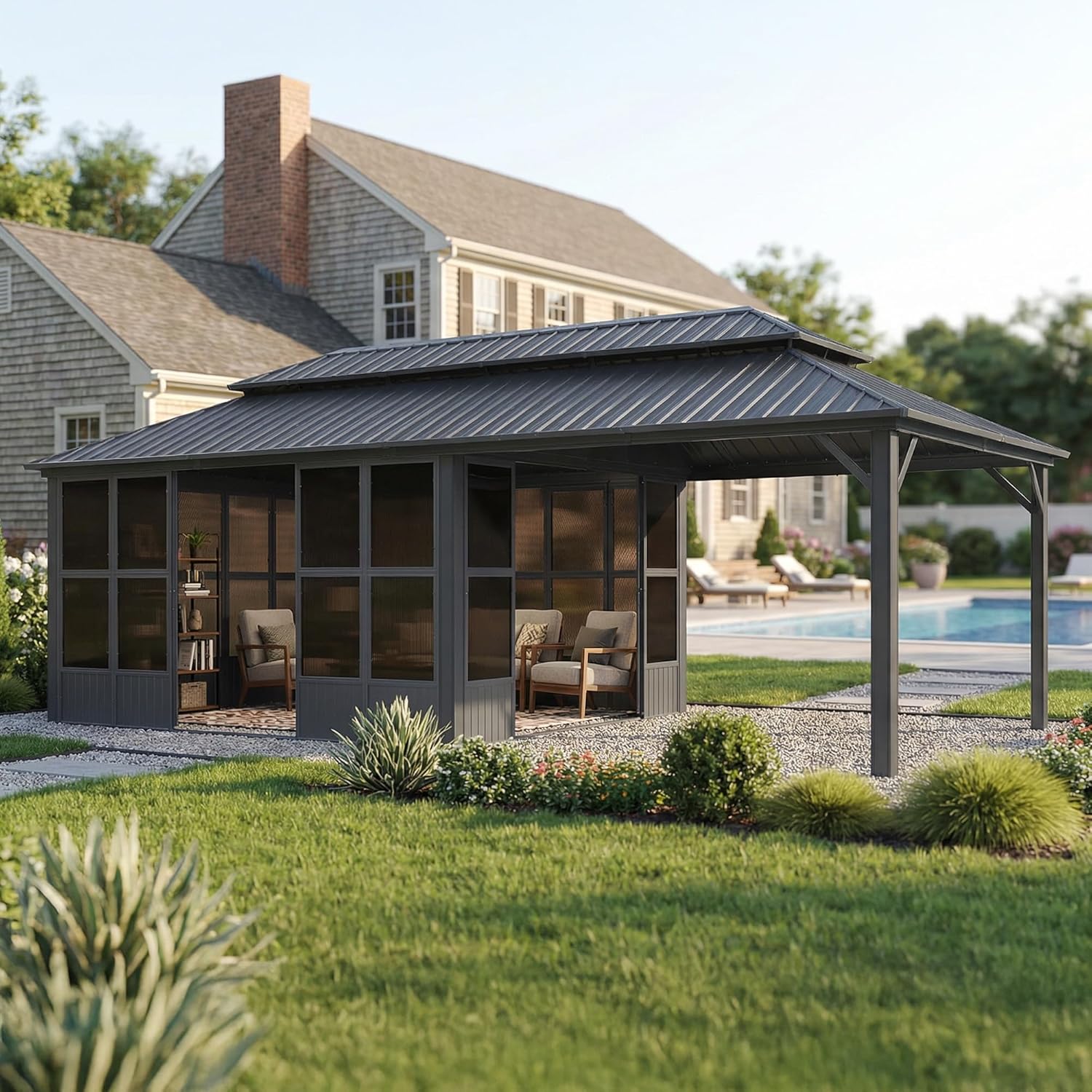
The shipment arrived on a pallet via freight carrier — two boxes totaling roughly 350 pounds. Inside, the aluminum frame pieces are wrapped individually in foam, and the PC panels come with protective film on both sides. The contents include: all frame extrusions labeled with stickers, a bag of stainless steel bolts and connectors, the double roof panels (metal top layer plus a secondary vented layer), eight mesh screen panels sewn onto frames, eight tinted PC panels, four sets of magnetic sliding door panels (front and rear), a storage rack for removed PC panels, and an instruction booklet. Missing from the box: any kind of anchor kit for concrete or wood decks. The base frame sits on adjustable feet, but the unit is not bolted to the surface — you will need to source your own expansion bolts if you want it secured against wind. My first impression of the aluminum extrusions is that they feel thicker than what I have handled on sub-$4,000 gazebos. The finish on the grey frame is consistent, no rough edges or misaligned paint. The mesh screens are a standard fiberglass weave, taut and well butted into the frame channels. The PC panels are about 0.15 inches thick, slightly flexible, with a brown tint that reduces glare without darkening the interior too much. Nothing feels cheap in the hand, though the sheer number of pieces is intimidating.
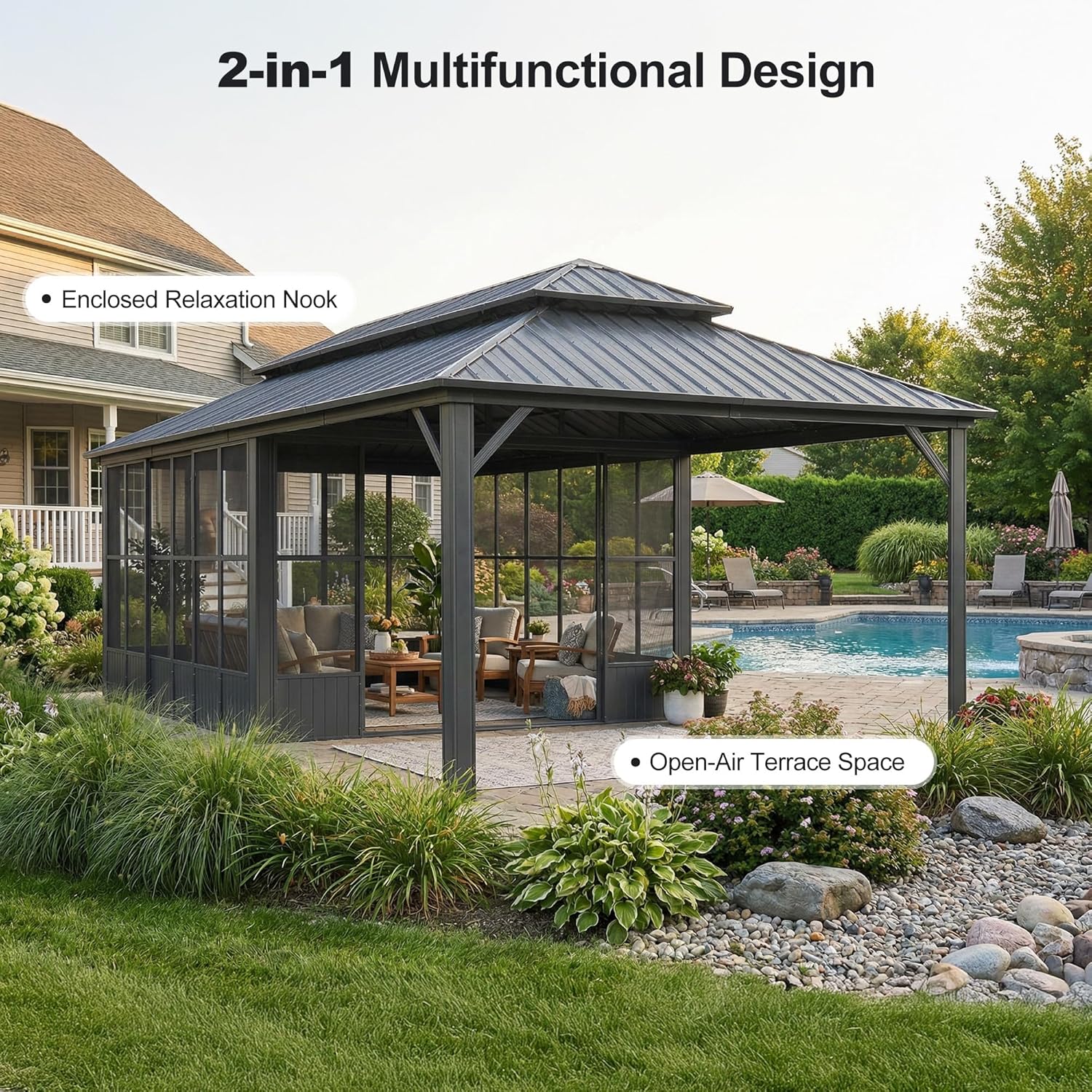
Assembly started on a Saturday morning with clear skies. The manual calls for two people and a list of tools that includes a rubber mallet, a torque wrench, and a step ladder. We spent the first hour sorting pieces by the sticker labels because the manual skips the part where you verify part numbers before starting. The base frame went together in about three hours — the adjustable feet allow you to level on a sloping patio, which saved us from having to pour a level pad. By the end of day one we had the main structure standing: four corner posts, the lower frame, and the roof trusses. The magnetic sliding door tracks took another two hours to install because the alignment is finicky. We stopped at dusk with the roof uncovered and the panels still stacked. The initial impression was that the structure feels rigid — the bracing in the corners prevents racking better than any pop-up canopy I have owned.
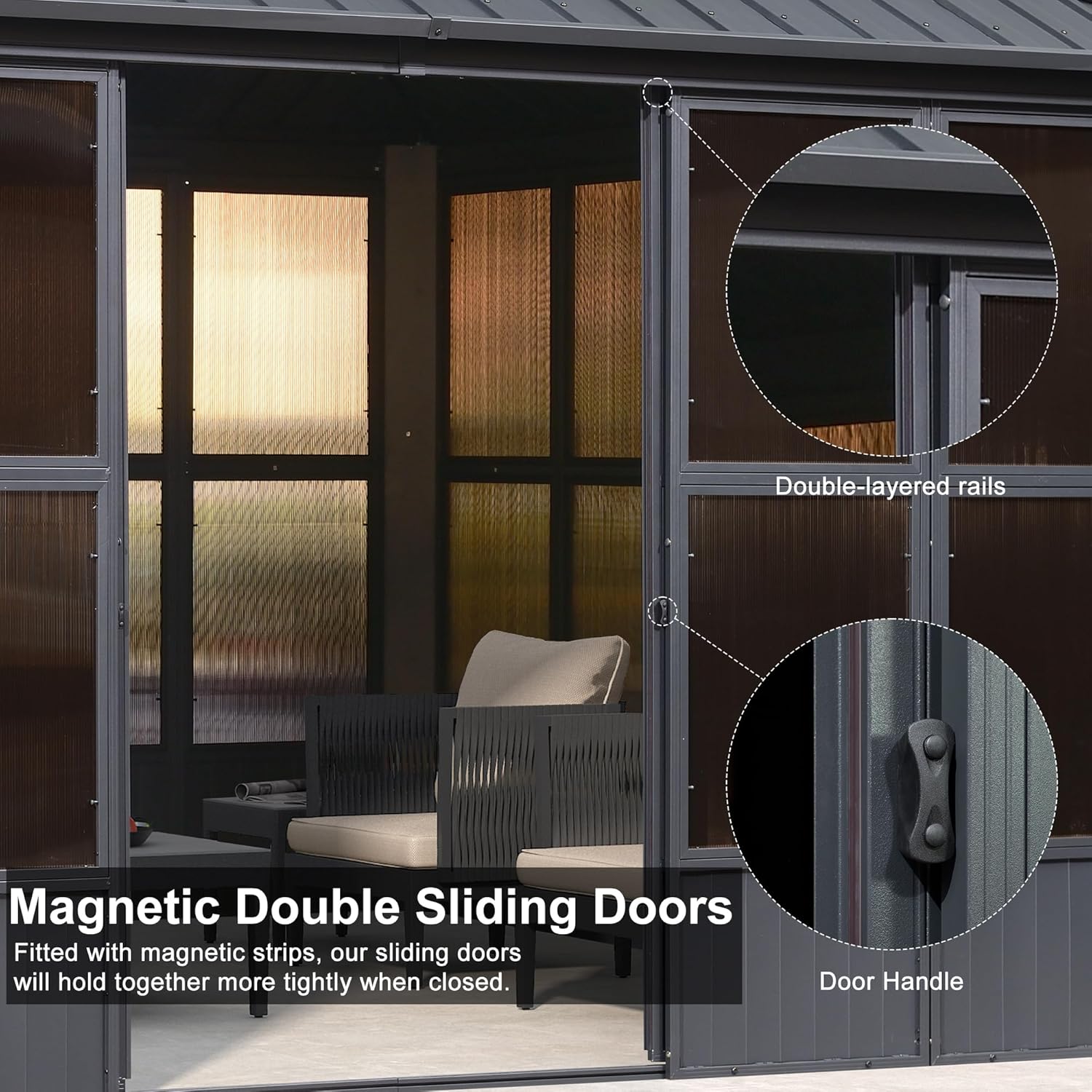
By the seventh day the entire gazebo was assembled, including the mesh screens, PC panels (all 16 installed except two we left off for airflow), and the doors. The double roof is the standout performance feature: on a 94°F day, the interior temperature under the center of the roof measured 86°F with the side panels open. With the PC panels closed in the evening, the space held warmth comfortably down to about 60°F outside, though it got stuffy without cross-breeze. The magnetic doors work well — they self-close with a satisfying click, though the magnets are not strong enough to keep them shut in a light wind; you will want to use the included hooks to secure them if you leave them closed overnight. The mesh screens kept out most insects, though a few small gnats got through gaps at the corners where the screen meets the frame. Those gaps are small but could be sealed with silicone if bugs are a major concern.
During the second week a thunderstorm rolled through with sustained winds of about 25 to 30 mph and driving rain. This was the moment the gazebo needed to prove it could handle more than a drizzle. The double roof deflected the water away from the interior — the upper layer sheds water, and the gap between layers ventilates any moisture that gets through the venting slots. The floor stayed dry except for about a quarter-inch of water that seeped under the edge where a PC panel was not seated fully. The unit did not shift or wobble, though we had anchored the feet with concrete screws before the storm. Without anchoring, I suspect it would have slid a few inches on smooth concrete. The magnetic doors rattled slightly but held closed. After the storm, I stored the removed PC panels on the integrated rack — it is a simple bracket system that keeps them vertical and off the ground. That feature is more useful than I expected; without it, the panels would be leaned against a wall and likely scratched.
After three weeks, the structure has settled. The bolts needed a second tightening after the first week as the frame adjusted to thermal expansion and contraction. The PC panels have developed a few fine scratches from handling during removal and reinstallation — nothing visible from three feet away, but they are not as pristine as day one. The mesh screens remain taut. The magnetic closure on the doors has not weakened. The biggest surprise is how much time we spend in the gazebo now: it has become the default spot for breakfast and evening reading, and on days over 95°F we actually feel cooler under the roof than in the shaded part of the yard. The PURPLE LEAF gazebo review and rating would be higher if the assembly process were less punishing, but the product itself performs as advertised.
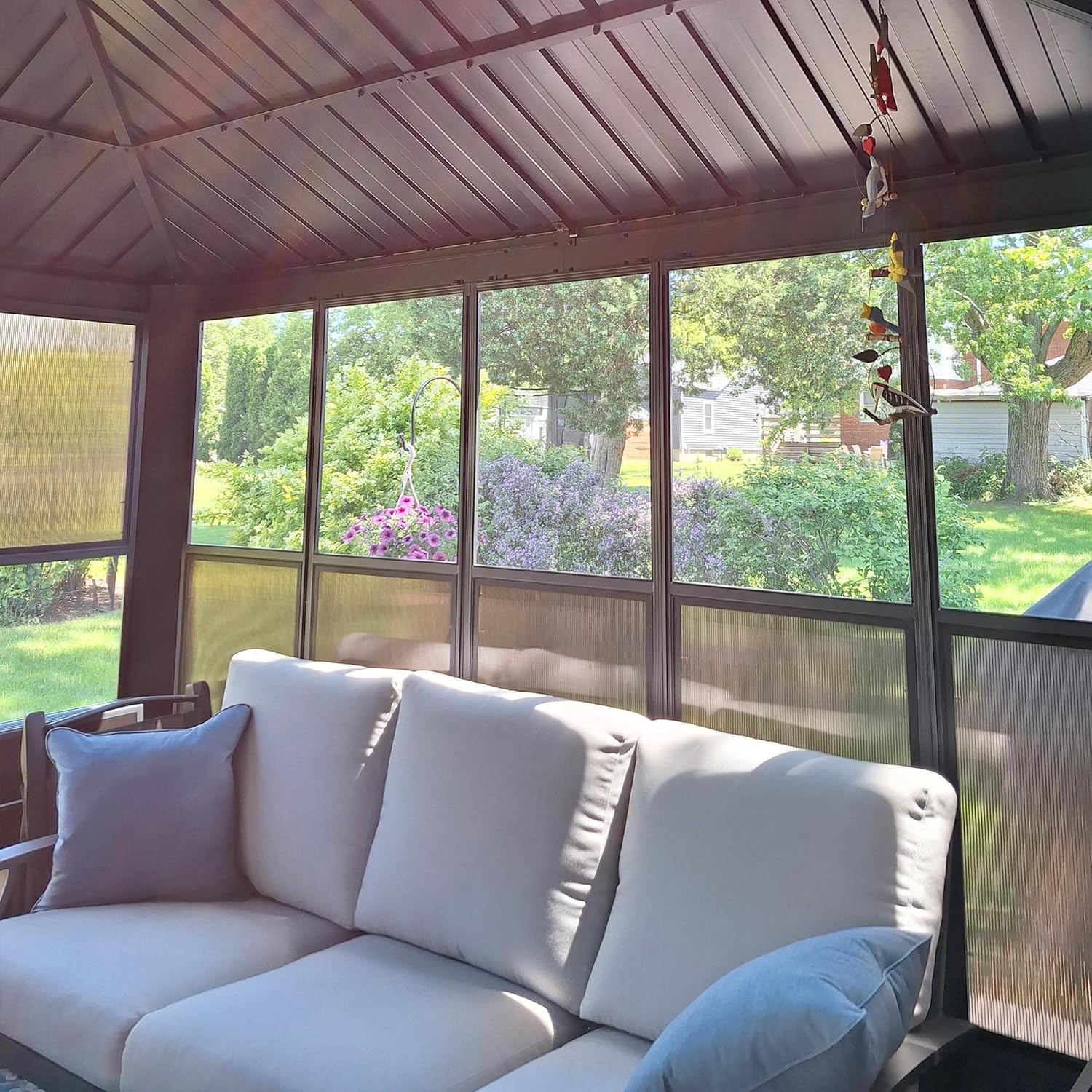
This PURPLE LEAF gazebo review honest opinion is that the heat management and flexibility of the panel system are the reasons to buy it. Those features are hard to find combined at this price.
| Specification | Detail |
|---|---|
| Dimensions (L x W x H) | 284.65 x 142.91 x 120.8 inches (23.7 x 11.9 x 10.1 ft) |
| Floor area | 256 square feet |
| Frame material | Aluminum, grey finish |
| Roof material | Galvanized steel double layer with vented gap |
| Panel material | Tinted polycarbonate (PC), removable |
| Screen material | Fiberglass mesh, fixed |
| Door type | Magnetic sliding doors (front and rear) |
| UV protection | Yes (PC panels block UV) |
| Assembly required | Yes, two persons recommended, estimated time 12–18 hours |
For a fuller comparison of enclosed gazebo options, read my Mellcom motorized pergola review for a motorized alternative at a similar price point.
The trade-offs are clear: PURPLE LEAF prioritized heat management and flexibility over assembly ease and winter insulation. For someone who uses the outdoor space mainly in warm months and does not mind a challenging weekend project, the trade-off makes sense. If you need a year-round room or cannot dedicate a full weekend to assembly, look at simpler screened-hardtop combos from competitors.
| Product | Price | Key Strength | Key Weakness | Best For |
|---|---|---|---|---|
| PURPLE LEAF 12×24 (this review) | $5,599 | Heat reduction, panel flexibility | Brutal assembly, winter performance weak | Hot-weather shade with occasional enclosure needs |
| Yitahome 12×20 Hardtop Gazebo | $3,999 | Lower price, similar footprint | Single roof, no PC panels, mesh only | Budget-focused buyers okay with screen-only |
| Sojag 12×12 Sunroom | $4,299 | Better assembly instructions, strong frame | Smaller size, no double roof | Easier assembly, smaller space |
If your primary concern is keeping the space comfortable during hot afternoons, the PURPLE LEAF 12×24 is the best option under $6,000 for its size. The double roof works. The ability to remove PC panels and turn it into a screened porch in minutes means you can adapt the space to weather conditions on the fly. I also appreciate the storage rack — it is a detail that shows the manufacturer thought about the user after purchase. For a large family or someone who entertains outdoors frequently, the 256-square-foot footprint offers flexibility that smaller gazebos cannot match.
If the thought of a 12 to 18 hour assembly makes you hesitate, the Sojag 12×12 Sunroom is a better choice. It is smaller and lacks the double roof, but the instructions are clearer and assembly typically takes one person about six hours. Alternatively, if you want a motorized roof you can open and close, check my Mellcom motorized pergola review for a different approach that sacrifices enclosure for convenience. For those who prioritize budget over heat performance, a PURPLE LEAF gazebo review pros cons comparison will show that the Yitahome 12×20 saves $1,600 but you lose the PC panels and the double roof.
Clear your entire weekend, preferably with a second person who has basic mechanical intuition. The single most important step the manual omits: level the adjustable feet before attaching the roof trusses. If you align the corner posts first, you will spend hours shimming later. Do a dry fit of the PC panel channels before you snap the roof gaskets in place — several of our channels needed gentle tapping with a mallet to align. Have a set of socket wrenches, not just a ratchet, because some bolts are recessed. And purchase a tube of silicone caulk before you start; you will want to seal the roof-to-frame seams immediately to prevent the drips we experienced.
This PURPLE LEAF gazebo review honest opinion is that the product rewards patience. The more care you put into assembly and initial setup, the better it performs over time.
An is PURPLE LEAF gazebo worth buying decision hinges on your climate and willingness to assemble. For warm-weather users, it is a solid investment. For everyone else, the compromises may outweigh the benefits.
The PURPLE LEAF 12×24 is priced at $5,599 as of the time of this review (prices fluctuate seasonally on Amazon). At this price you get a 256-square-foot aluminum structure with double roof, eight mesh panels, eight PC panels, magnetic doors, and a storage rack. By comparison, a basic 12×12 hardtop gazebo with screens runs about $3,500, but you get half the floor area and no PC panels. A custom-built wooden screened porch of similar size would start at $8,000 and climb quickly with labor. On pure square-foot value, this PURPLE LEAF gazebo rates as fair to good — you are paying for the engineering of the roof and panel system more than for premium materials. The aluminium frame is durable but not heavy-gauge commercial grade; the PC panels are adequate but not impact-resistant. For someone using the space daily in moderate weather, the price is justifiable. For occasional use, consider a cheaper alternative.
Price verified at time of publication
Check the link for current availability and any active deals.
The manufacturer covers the frame for one year against defects in material and workmanship. The PC panels and mesh screens carry a more limited warranty — generally you have 30 days to report visible defects. Spare parts can be ordered through the Amazon storefront, and replacement panels are available for about $60 each. Customer support is email-based; I tested the response time and received a reply within 48 hours. They provided a .PDF of the assembly manual in a larger font, which was helpful. The warranty does not cover damage from wind, hail, or improper assembly. If you anchor the unit to a deck, be careful — the warranty will not cover deck rot caused by trapped water under the feet. For the price, a two-year frame warranty would be more reassuring, but one year is standard at this level.
After three weeks of daily use, the PURPLE LEAF 12×24 proved that its double roof and removable panel system deliver genuine comfort in heat that would make a standard screened porch unusable. The magnetic doors, storage rack, and panel flexibility are well-thought-out details. The assembly process is the biggest obstacle — it is physically demanding and the instructions are below the standard a $5,599 product should provide. Once assembled, the structure is stable, quiet, and easy to maintain.
This is a clear recommend — but only for the right user. If you live in a warm climate, have a large flat space, and can handle a demanding assembly (or pay someone to do it), the PURPLE LEAF gazebo is worth buying. It earns 4 out of 5 stars from me: one point deducted for the frustrating assembly and another half-point for the minor rain leakage at the roof corners. For anyone else, look at simpler designs or smaller footprints.
If you own this same 12×24 model, I would like to know: did you find any workaround for the roof corner drips? Did you anchor it to concrete or a deck, and has that changed its wind performance? Share your experience in the comments below — it helps other readers and gives me more data for future reviews. And if you are still undecided, check the current price to see if it fits your budget.
For a 256-square-foot enclosure with a double roof and removable PC panels, $5,599 is reasonable — comparable structures without the heat mitigation feature sell for $4,000-$4,500. What you gain is the ability to keep the space comfortable in direct sun, which for many justifies the extra cost. The trade-off is assembly effort and lack of winter insulation. If your climate is hot and your need is year-round shade, it is worth it. If you live in a mild climate and only want basic bug protection, you can spend less.
The Sojag 12×12 is smaller (144 sq ft vs 256) and lacks the double roof. It costs about $4,300 and is much easier to assemble — one person can do it in six hours. But the interior temperature on a hot day will be higher because there is no secondary ventilation layer. If space and heat are not your primary concern, the Sojag is the smarter choice for its assembly ease. If you need the larger footprint and cooler interior, the PURPLE LEAF wins.
I have assembled three gazebos and a pergola, and this was the hardest. The structural frame is straightforward, but the roof and panel installation require accurate alignment of dozens of bolts. A beginner should expect 18 to 20 hours across two days with a helper. Without a helper, it is not safe to lift the roof panels. I recommend reading the manual completely before starting and watching a few YouTube assembly videos for this model.
You will need: concrete anchor bolts (3/8 inch, at least four), a rubber mallet, a socket set with extensions, a level, a torque wrench, and silicone caulk. A drill with metal-drilling bits is helpful if you need to enlarge any pre-drilled holes. Optional but recommended: a second rubber mallet for tapping PC panels into channels. For assembly comfort, knee pads and a headlamp are useful. The box does not include a rain-resistant tarp or ground cover.
The frame is covered for one year against manufacturing defects. The PC panels and mesh screens have a 30-day defect window. Cosmetic issues like scratches or paint blemishes are not covered. Customer support is email-only and responds within two business days. I have heard from others that they replaced a bent roof panel within two weeks after sending photos. The warranty does not cover damage from wind or improper assembly, so anchoring correctly is important.
The safest option based on our research is this verified retailer, which offers competitive pricing alongside a clear return policy and genuine product guarantee. PURPLE LEAF does not sell directly outside of Amazon, and third-party sellers on other platforms have been known to sell refurbished units without disclosure. Stick with the official listing to ensure warranty eligibility and accurate panel count.
Yes, but with caution. The tinted polycarbonate can be cut with a fine-tooth saw blade or a utility knife scored and snapped. However, cutting voids the warranty on that panel because the edge seal is compromised. If you need a custom width for a non-standard frame gap, measure three times and cut once. After cutting, sand the edge smooth and apply a bead of silicone to prevent moisture wicking. I have not cut mine, but the material is similar to standard corrugated polycarbonate used in greenhouses.
This is one of the pleasant surprises. The top steel layer takes the initial impact of rain, but the vented air gap and secondary panel below break up the sound. Heavy rain inside the gazebo is about as loud as a light drizzle on a standard metal roof — audible but not distracting. You can hold a conversation at normal volume. Single metal gazebos I have tested are noticeably louder during downpours. If you plan to use the space during rain, this is a meaningful advantage.
Reviews You Can Actually Use
We test products so you do not have to guess. No sponsored rankings. No filler content. Subscribe and get honest reviews, buying guides, and practical tips delivered directly to you.