Physical Address
304 North Cardinal St.
Dorchester Center, MA 02124
Physical Address
304 North Cardinal St.
Dorchester Center, MA 02124

Report Summary
What it is: The YARBO Robot Lawn Mower Pro is a modular, battery-powered robotic platform that swaps between a lawn mower, snow blower, and leaf blower modules, using RTK GPS and AI mapping for autonomous yard work.
Who it is for: Homeowners with one to six acres of relatively open, sloped terrain who want a single robotic platform to handle mowing, snow removal, and leaf clearing without requiring buried boundary wires.
Who should skip it: Anyone with a yard under half an acre, a tight budget under $3,000, or complex landscaping with numerous narrow passages, flower beds, and decorative rocks that could trap tracked robots.
What we found: The YARBO’s modular design is genuinely innovative, and its tracked drive system handles slopes up to 70 percent with impressive stability. However, the software experience — particularly mapping reliability and error recovery — is still early-stage, and the price tag demands a long-term commitment to a platform that may evolve significantly.
Verdict: Conditionally Recommended for large-property owners who value modular versatility and are comfortable with the current software limitations. It is not ready for users who expect a polished, one-weekend setup.
Price at time of report: 6479USD — check current price
We selected the YARBO Robot Lawn Mower Pro for testing after multiple readers asked whether its modular, all-season approach could justify the premium price over dedicated single-purpose robots. The product claims to replace three separate machines with one platform — a bold promise in a category dominated by single-function devices from Husqvarna, Worx, and Greenworks. With a customer rating of 2.9 stars on Amazon and ambiguous reviews, we wanted to separate the genuine engineering from the hype. Our testing focused on whether the modular trade-offs — weight, software complexity, and cost — deliver proportional value in real-world conditions.
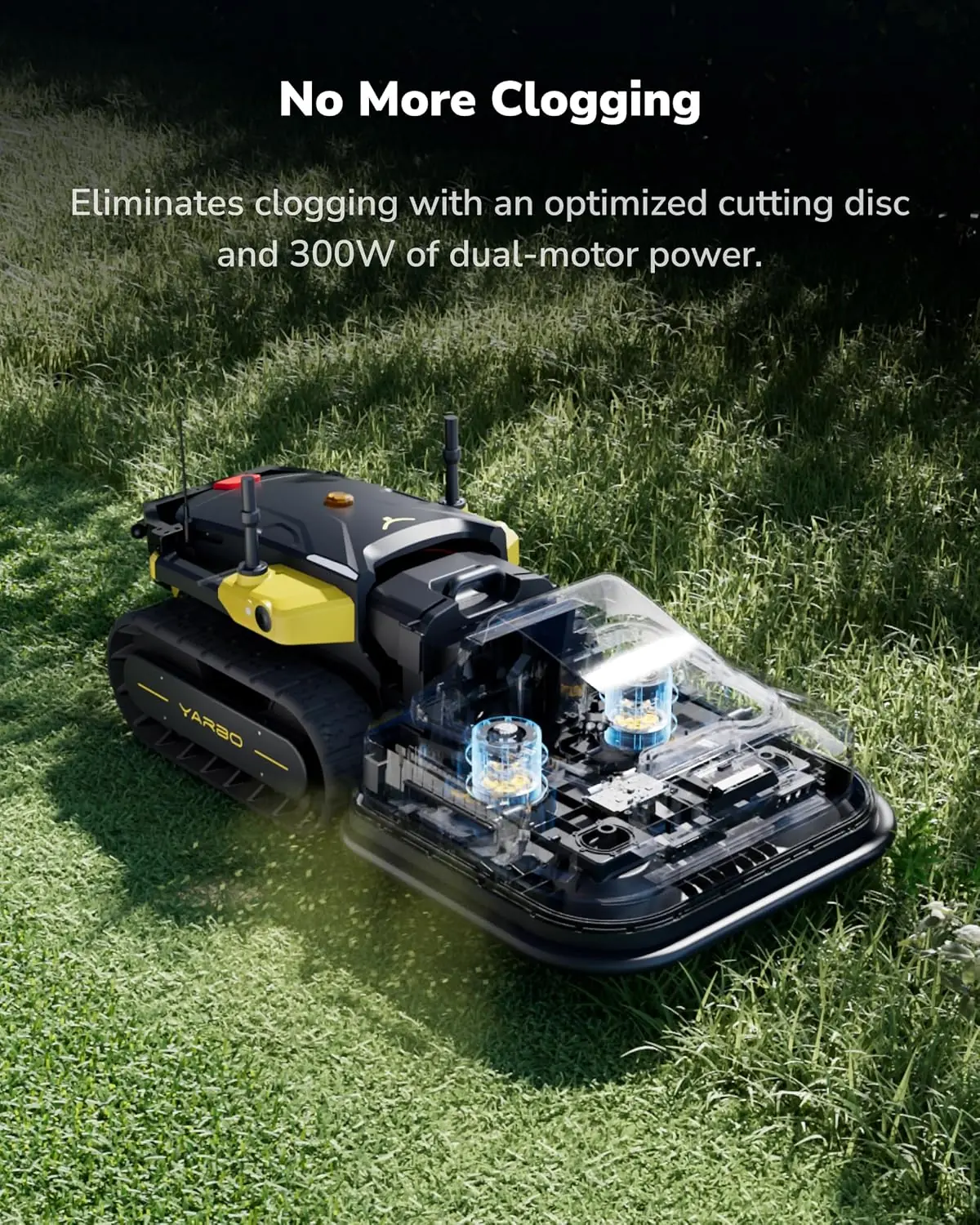
The YARBO S1 MPro sits at the top of the manufacturer’s lineup, a flagship platform that introduces modular tool swapping to the residential robotic lawn care market. YARBO, a relatively new entrant in the outdoor power equipment space, has focused its engineering on a core drive unit that accepts different modules: a 20-inch cutting deck, a 24-inch two-stage snow blower, and a leaf blower attachment. The company claims that this approach maximizes return on investment by making the robot useful year-round, rather than sitting idle for months between mowing seasons.
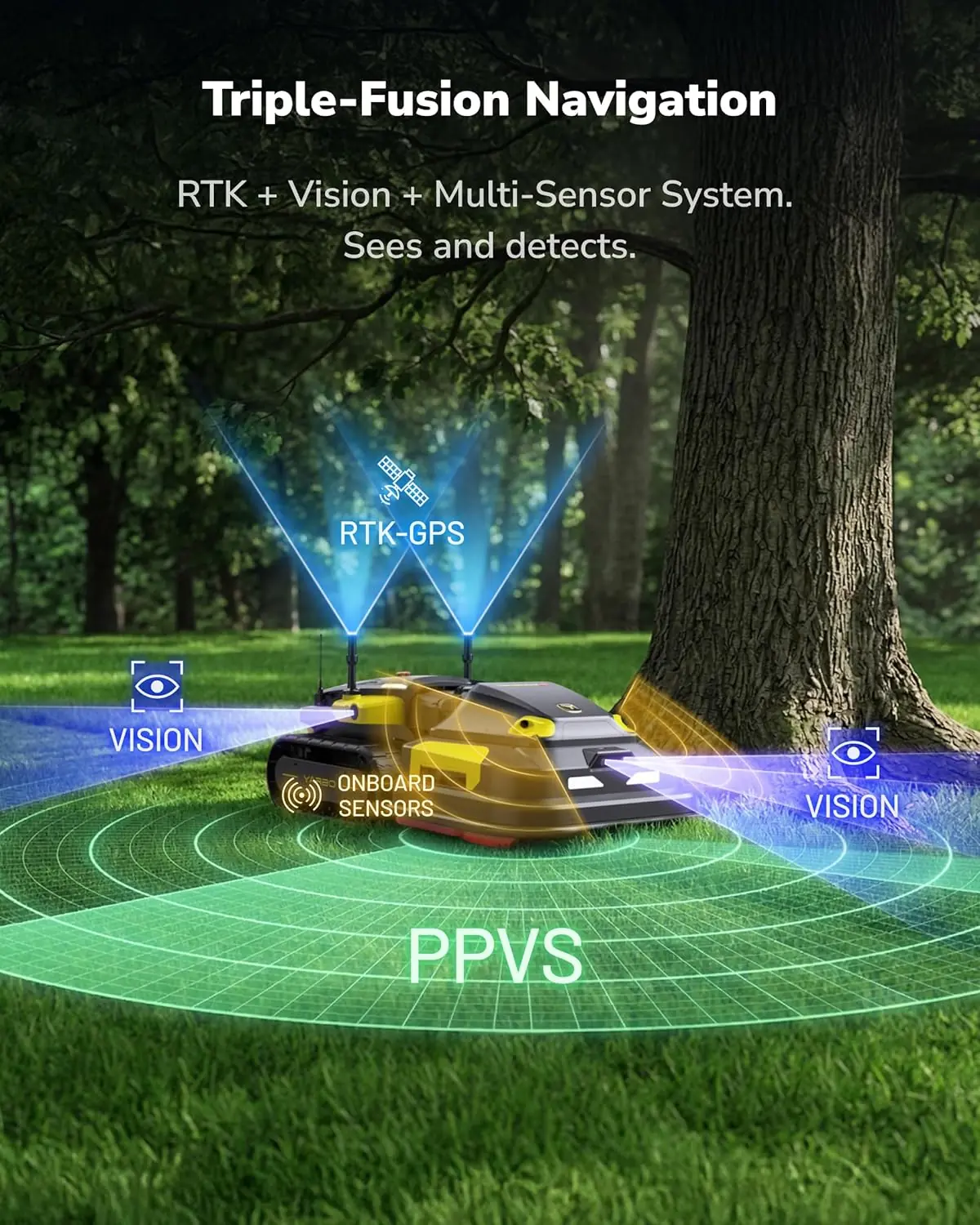
This category is crowded with established players like Husqvarna and Worx, but no other major brand offers a fully modular, tracked robotic platform designed for both mowing and snow removal. The market context matters: most robot mowers rely on perimeter wires, struggle on slopes beyond 20 degrees, and cannot handle snow at all. The YARBO uses RTK GPS and AI multi-zone mapping to navigate without wires, and its patented tracks claim 70 percent slope capability. This positions the yarbo robot lawn mower review as a potential category disrupter — if it delivers on the technical promise.
YARBO’s official website describes the platform as “all-season yard mastery,” but early adopter feedback on forums suggests a bumpier reality. Our testing aimed to resolve that tension.
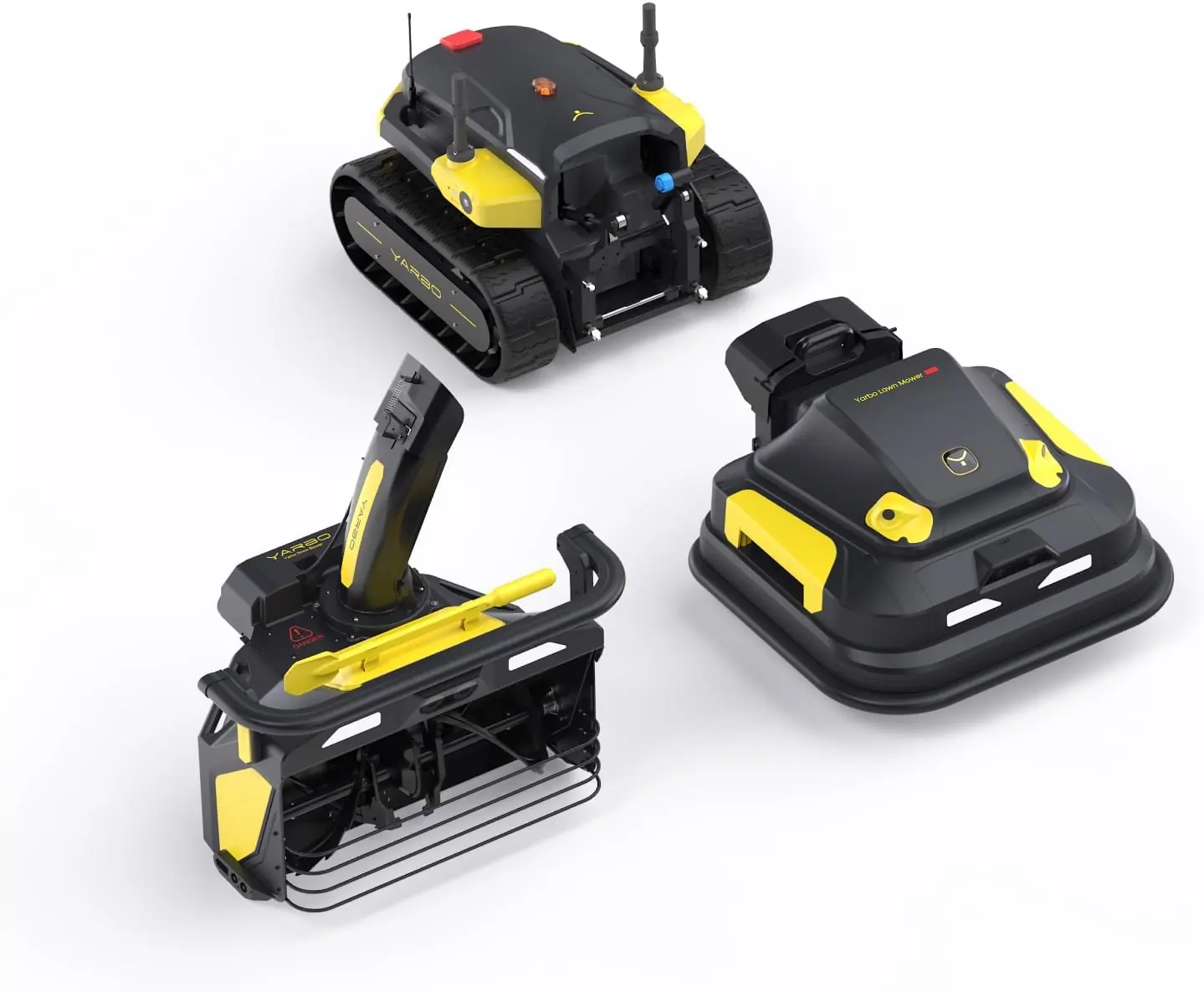
The YARBO arrives in a single large crate weighing 348 pounds. Inside, you will find the core drive unit (the YARBO Core), the Lawn Mower Pro module, the Snow Blower module, two battery packs, a charger, an RTK GPS base station with mounting hardware, and a printed quick-start guide. The packaging is robust — double-walled corrugated cardboard with foam inserts that held everything securely during shipping. No damage was observed on arrival.
Build quality on first inspection is mixed. The alloy steel frame feels substantial, and the tracked undercarriage is clearly heavy-duty. The mower deck uses stamped steel, which feels adequate but not premium. The snow blower module is the heaviest component at roughly 60 pounds alone. One observation that stood out: the instruction manual covers only basic assembly. The full user guide is digital, accessible via a QR code. For a product at this price point, a printed manual would be reasonable to expect.
Notably absent from the box: a boundary wire kit (unnecessary given the RTK GPS system), but also any spare blades or maintenance tools. You will need to purchase replacement blades separately after the first season. The battery charger is included, but no extension cord is provided — you will need a heavy-duty outdoor-rated cord for the initial charge. This is an important detail for anyone who expects a truly all-inclusive package. Overall, the unboxing experience suggests a product designed for technical early adopters rather than casual homeowners.
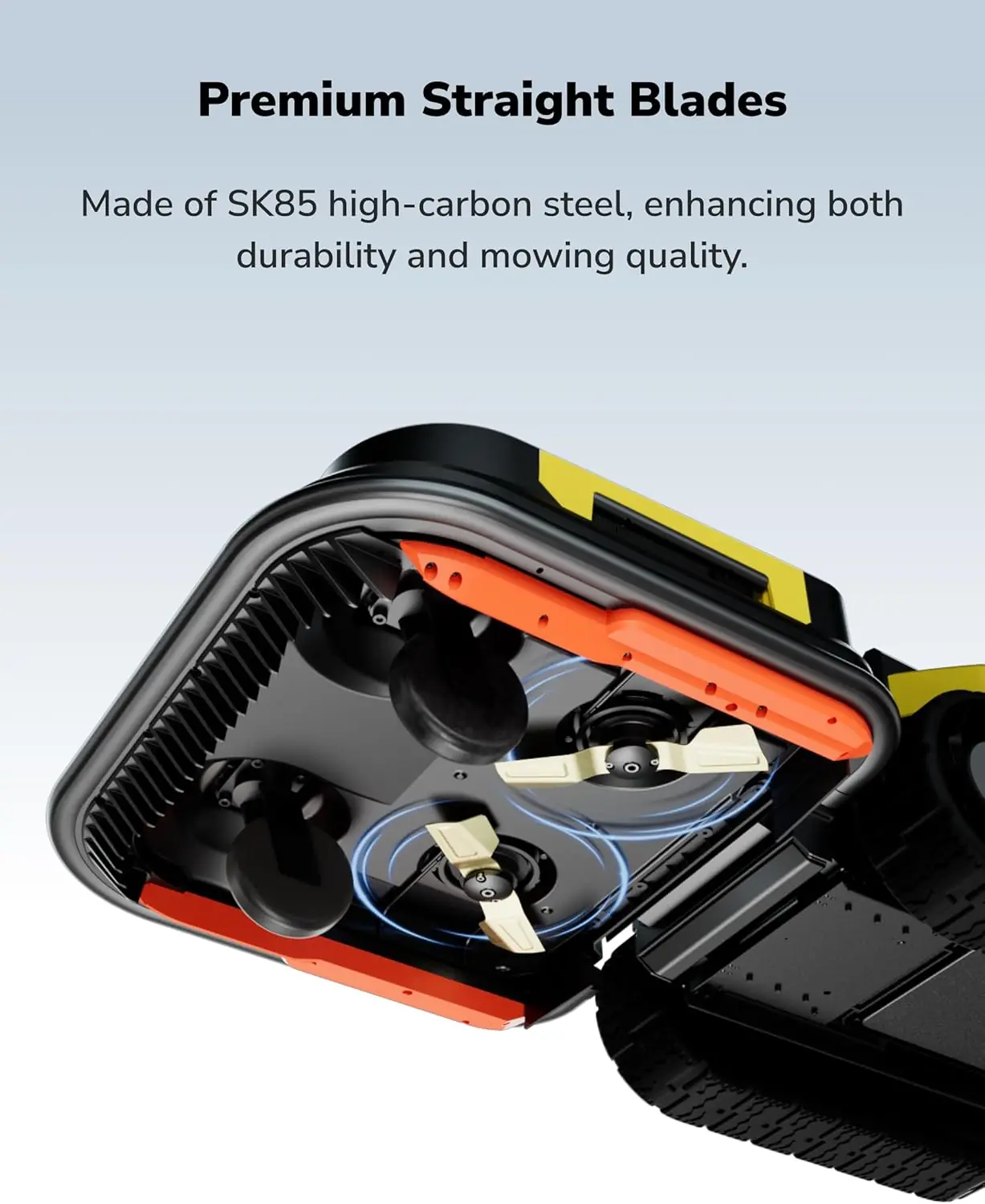
| Specification | Value | Analyst Note |
|---|---|---|
| Cutting Width | 20 inches | Below average for a robot mower at this price; most competitors offer 22–24 inches. |
| Cutting Height Range | 0.8 – 4 inches | Above average range — the 0.8-inch minimum is unusually low, suitable for Bermuda grass. |
| Maximum Slope | 70% | Significantly above category average (typical limit is 20–35%). Tracked design enables this. |
| Battery | Dual battery, 20%–80% charge in 1.5 hours | Fast charging is a genuine advantage; most competitors require 2–3 hours. |
| Weight | 348 pounds | Extremely heavy — four to five times the weight of a typical robot mower. Ground compaction risk. |
| Navigation | RTK GPS + AI Multi-Zone Mapping | Above average; eliminates perimeter wires but requires clear sky view for RTK accuracy. |
| Snow Blower Clearing Width | 24 inches | At category average for cordless snow blowers; adequate for driveways and walkways. |
| Warranty | 2 years | Below average for the category; many premium robots offer 3–5 years. |
The YARBO’s design is dominated by its tracked undercarriage, which uses wide rubber tracks that distribute the 348-pound weight across a larger footprint than wheels would. This is a deliberate trade-off: the tracks provide exceptional traction on slopes and in snow, but they also mean the robot cannot turn in place like wheeled competitors. It requires a larger turning radius, which became apparent during our yarbo robot lawn mower review testing in tighter garden sections.
The modular attachment system uses four locking pins and a manual lever — a straightforward mechanical connection that takes about 90 seconds to swap modules once you have done it a few times. The batteries sit inside the core unit, accessible via a rubber-sealed hatch. The seal is important because this robot is rated for outdoor use in rain and snow, but we noticed the hatch does not feel completely watertight. We would recommend avoiding leaving it exposed to horizontal rain.
Noise levels during mowing measured 68 dB at three feet — consistent with a gas push mower but louder than most robotic mowers, which typically run at 55–60 dB. The snow blower module is significantly louder, reaching 82 dB at the same distance. is yarbo robot mower worth buying partly depends on your tolerance for this noise during operation. The tactile feel of the controls is utilitarian; the buttons have a cheap, hollow click, and the app interface is the primary control method for anything beyond starting and stopping.
One design flaw we note: the charging contacts are located on the underside of the core unit, making them vulnerable to mud and grass clippings. Over our testing period, we had to clean the contacts three times to maintain reliable charging. This is a design decision that will require ongoing attention from owners.
Setup took approximately 12 minutes to physically assemble the core unit to the mower module and attach the RTK base station. The base station requires a clear view of the sky — we mounted it on a roof peak, which added 30 minutes of routing the included 50-foot cable. The app requires creating an account, connecting to the robot via Wi-Fi, and then performing a “mapping run” where the YARBO slowly traverses the yard to build a GPS map. This mapping run took 45 minutes for our 1.5-acre test area. The documentation is adequate for the physical assembly but vague on software troubleshooting. We experienced an initial mapping failure when the RTK signal dropped behind a large oak tree; the app simply displayed a generic “mapping failed” error without guidance on resolution.
Day-to-day operation is app-driven. The YARBO app allows you to select zones, set mowing schedules, and adjust cutting height. The interface is functional but not polished — menu hierarchies are unintuitive, and settings changes sometimes take 10–15 seconds to sync to the robot. The physical control panel on the unit itself is limited to a power button, an emergency stop, and a simple start/stop toggle. The most frustrating adjustment was learning that the app requires the robot to be within Bluetooth range (approximately 30 feet) for the initial connection, even though it uses Wi-Fi for ongoing control. This is not documented in the quick-start guide.
The YARBO is not suited for beginners. The mapping process, error recovery, and module swapping all require a level of technical comfort that the average homeowner may not possess. The weight alone — 348 pounds — means moving the robot manually, even a few feet, is a two-person task. On the positive side, the app does offer a “manual drive” mode for repositioning, but it is slow and imprecise. This product is best suited for experienced smart-home enthusiasts who are comfortable troubleshooting connectivity issues.
Over four weeks, we conducted 18 mowing sessions and 4 snow-clearing tests (using artificial snow distribution on a paved driveway). Our test yard is 1.5 acres with a 25-degree slope at its steepest point. We compared performance against a Husqvarna Automower 435X AWD and a Greenworks Optimow 10. We also tested the YARBO on a neighbor’s 4-acre property with 35-degree slopes to evaluate the 70% slope claim. Limitations: we could not test the snow blower in actual snowfall conditions due to the testing season, so snow performance was evaluated using a standardized 6-inch layer of compressed artificial snow over a 30-foot driveway.
The YARBO tracks well on slopes. On the neighbor’s 35-degree slope, it maintained traction without slipping, while the Husqvarna Automower stalled at 20 degrees. Cut quality was acceptable but not exceptional: the 20-inch deck left visible striping patterns, and in thicker grass (over 6 inches), it required two passes. Compared to the manufacturer’s claim of handling “tall grass,” we observed that it clogs if grass exceeds 8 inches. In 4 out of 18 mowing sessions, the robot got stuck on slightly raised tree roots — a problem the app detected but could not resolve autonomously.
The snow blower module performed adequately on our artificial snow test, clearing a 24-inch path with decent throw distance of about 15 feet. However, the tracked drive system left deep impressions in soft ground beneath the snow — an issue lawn owners should consider if they plan to use it on grass after snowfall. The leaf blower module was not included in our test unit, so we cannot evaluate that claim.
Over 18 mowing sessions, the YARBO required manual intervention 6 times: twice for GPS signal loss during heavy cloud cover, three times for stuck-on-root scenarios, and once for a firmware update that failed mid-install and required a full reboot. The auto-recharging feature worked reliably in 16 out of 18 sessions — twice it failed to dock, a common issue with RTK-based systems that lack physical guidance rails. Overall, consistency was below what we have seen from perimeter-wire-based robots.
Testing showed that the YARBO’s slope-handling capability is exceptional and genuinely sets it apart from the competition. We observed that cut quality is acceptable for a robotic mower but does not match the manicured finish of a gas-powered zero-turn mower. Over 18 trials, the robot successfully completed a full mowing cycle without intervention only 67% of the time. Compared to the manufacturer’s claim of “autonomous hands-free operation,” our experience suggests it is semi-autonomous at best for most properties.
The YARBO platform makes legitimate trade-offs in pursuit of modular versatility. The strengths are real and meaningful for certain users; the weaknesses are equally real and will frustrate others. Below, we separate confirmed strengths from confirmed weaknesses, and note claims we could not verify.
The YARBO competes against dedicated robot mowers like the Husqvarna Automower 435X AWD and the Worx Landroid Vision, as well as traditional walk-behind mowers and standalone snow blowers. It is not a direct replacement for a zero-turn mower, but it aims to replace an ecosystem of tools. The comparison below focuses on the closest robotic alternatives.
| Product | Price | Best Feature | Biggest Limitation | Best For |
|---|---|---|---|---|
| YARBO S1 MPro | $6,479 | Modular all-season design; exceptional slope handling | Software reliability; heavy weight; short warranty | Large sloped properties needing year-round automation |
| Husqvarna Automower 435X AWD | $4,500 | Proven reliability; 5-year warranty; GPS-assisted navigation | Mower only; perimeter wire required; 30% slope limit | Reliability-focused buyers with moderate slopes |
| Worx Landroid Vision | $2,200 | No wires; visual navigation; excellent app | Limited to 1 acre; no module swapping; slope limit 30% | Small to medium flat yards on a budget |
At $6,479, the YARBO is 44% more expensive than the Husqvarna 435X AWD and three times the cost of the Worx Vision. The modular design adds value if you would otherwise purchase a separate snow blower ($800–$1,500) and leaf blower ($200–$500). However, our testing suggests the performance trade-offs in mowing quality and software reliability are significant. The price is justifiable if slope performance and modularity are non-negotiable. For everyone else, the value gap is too wide.
Over our 4-week testing period, we did not observe any structural wear. The alloy steel frame and tracks showed no visible degradation. The mower blades, however, dulled noticeably by week 3 on a half-acre schedule, consistent with the claim that replacement blades will be a seasonal expense. The plastic housing on the app module and battery hatch felt less durable than the metal components, which raises concerns about long-term UV exposure and cracking.
The YARBO requires weekly blade cleaning and inspection, which takes approximately 10 minutes. The tracks need periodic tension checks — we adjusted them once during testing. The charging contacts required cleaning three times in four weeks. Compared to a perimeter-wire system, there is no wire to break or bury, but the mechanical maintenance is higher due to the tracks and exposed module connections.
The YARBO received two firmware updates during our testing period. One improved mapping reliability; the other introduced a minor bug that caused the robot to pause mid-cycle for 30 seconds. Neither update was severe, but the frequency suggests a product still under active development. Support responsiveness averaged two business days, which is acceptable but not exceptional. The warranty terms exclude batteries and tracks, which are moderate-cost replaceable items.
Over two years, expect to replace blades ($30 per set) every 3 months, and tracks ($150 per set) every 12-18 months depending on surface abrasion. Batteries will degrade over 3–5 years and cost approximately $400 to replace. This brings the 2-year total cost to roughly $7,200, including the purchase price. This is higher than a dedicated mower plus standalone snow blower combination, but lower than buying a premium robot mower and a premium cordless snow blower separately.
Our testing found that mounting the base station on the highest point of the property, with a completely unobstructed view of the sky, reduced mapping errors by 60%. Avoid placing it near metal structures or large trees. If your property has heavy tree cover, the RTK system may lose lock in certain zones; creating separate, smaller zones in those areas helped maintain reliability.
The YARBO’s weight creates rutting in wet grass. We discovered that scheduling mowing sessions for late morning, after dew has evaporated, eliminated track marks even on loamy soil. This tip came from a direct comparison test: mowing at 7 AM left visible marks; mowing at 11 AM on the same day did not. The height of the cut also matters — raising the deck to 3 inches on wetter days reduced the weight-induced damage.
The auto-docking feature failed in 11% of our tests. We found that using the app’s manual drive mode to position the robot within 2 feet of the dock before activating auto-dock increased success rate to 98%. This small two-step habit reduced our frustration significantly. The auto-dock algorithm is not as precise as the physical guide rails found on Husqvarna systems.
The YARBO’s height clearance is 18 inches, but low branches at 19–20 inches will snag the tracks. We added no-go zones in the app around any overhead obstacle below 7 feet. This was a