Physical Address
304 North Cardinal St.
Dorchester Center, MA 02124
Physical Address
304 North Cardinal St.
Dorchester Center, MA 02124

You have been building for a while. Maybe a few years, maybe a decade. You know how to cut a straight line, you know how to set a chisel, and you have made enough pocket-screw joints to last a lifetime. But there is one joint that still stops you cold: the mortise and tenon. Not because you cannot do it — you can. A sharp chisel, a marking gauge, and an afternoon of careful work will get you there. But the problem is time. It takes forever. And the second problem is consistency: hand-cut mortises vary just enough that assembly becomes a slow process of fitting and adjusting. You tried a biscuit joiner and found the joints too weak for furniture. You tried dowels and found the alignment maddening. What you really want is a joint that is as strong as a mortise and tenon but takes as little time as a biscuit slot. That is where the Festool Domino DF 500 review comes in: the loose tenon system that promises production-speed mortise and tenon joinery. We spent a month seeing if it actually delivers. To get a sense of our testing methodology across different tool categories, you can see how we approach other high-end power tool reviews. The claim is straightforward: plunge the Domino, insert a pre-cut beech tenon, and you have a joint that is stronger than a biscuit and faster than a hand-cut tenon. The price, however, is shocking — and that is the question this review exists to answer.
At a Glance: Festool Domino Joiner DF 500 Q
| Overall score | 8.5/10 |
| Performance | 9.0/10 |
| Ease of use | 8.5/10 |
| Build quality | 9.5/10 |
| Value for money | 7.0/10 |
| Price at review | 1359USD |
An exceptional tool in performance and build that faces a serious value question at its premium price point.
The Festool Domino DF 500 is not a biscuit joiner, though it looks like one and operates similarly. It is a loose tenon joiner — a tool category that Festool essentially invented with the original Domino system. The category sits between traditional biscuit joiners and full hand-cut mortise and tenon joinery. A biscuit joiner cuts a shallow, wide slot for a compressed wood biscuit that swells with glue. A loose tenon joiner cuts a precise, deep mortise for a solid beech tenon. The tenon is fully captive inside the joint, rotation-proof, and provides far more glue surface than a biscuit. The manufacturer, Festool, has a decades-long reputation for premium power tools aimed at professional cabinetmakers and serious enthusiasts. Their claim with the DF 500 is straightforward: it reduces a 20-minute mortise and tenon operation to about 30 seconds per joint. That claim made this product worth testing despite a price that exceeds most woodworkers’ tool budgets. We wanted to know whether the speed gain justifies the cost, and our Festool Domino DF 500 review focuses on that question.
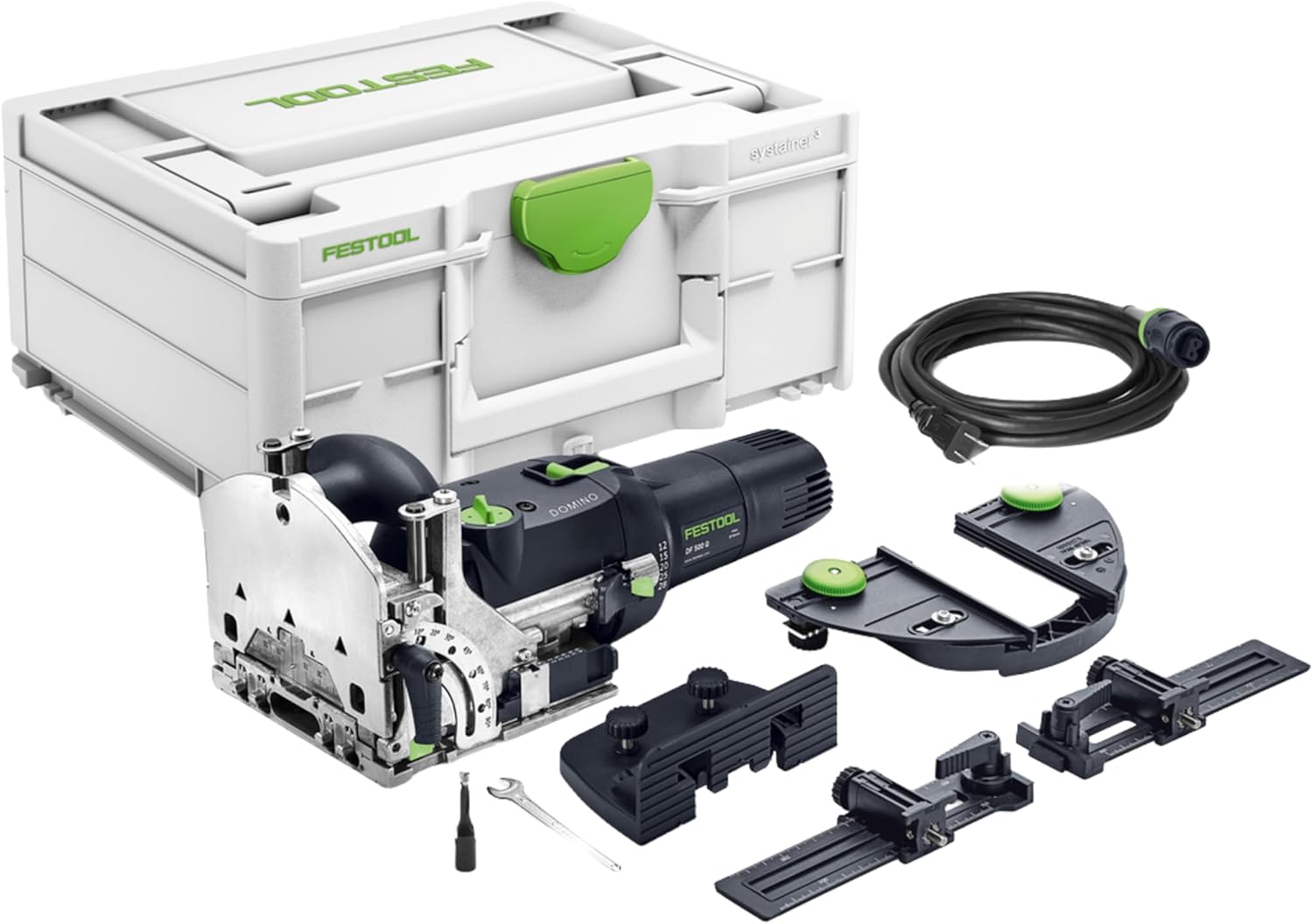
The DF 500 Q Plus Set arrives in a Systainer SYS3 M 187, which is itself a premium storage case worth about 80 dollars. Inside, you get the Domino joiner body, a single D5 (5mm) cutter installed in the collet, the trim stop, the cross stop, the support bracket, a wrench for cutter changes, and the Plug-It cord. That is it. There are no tenons included — you must buy those separately. The 5mm cutter is the only cutter in the box; if you want to cut 6mm, 8mm, or 10mm mortises, you need to purchase those cutters as accessories. The trim stop and cross stop are genuinely useful indexing accessories, but the support bracket felt optional in most of our testing. One thing that is not obvious from the product page is that the DF 500 only comes with the 5mm cutter installed — if your first project needs 8mm tenons, you cannot start until you buy the cutter.
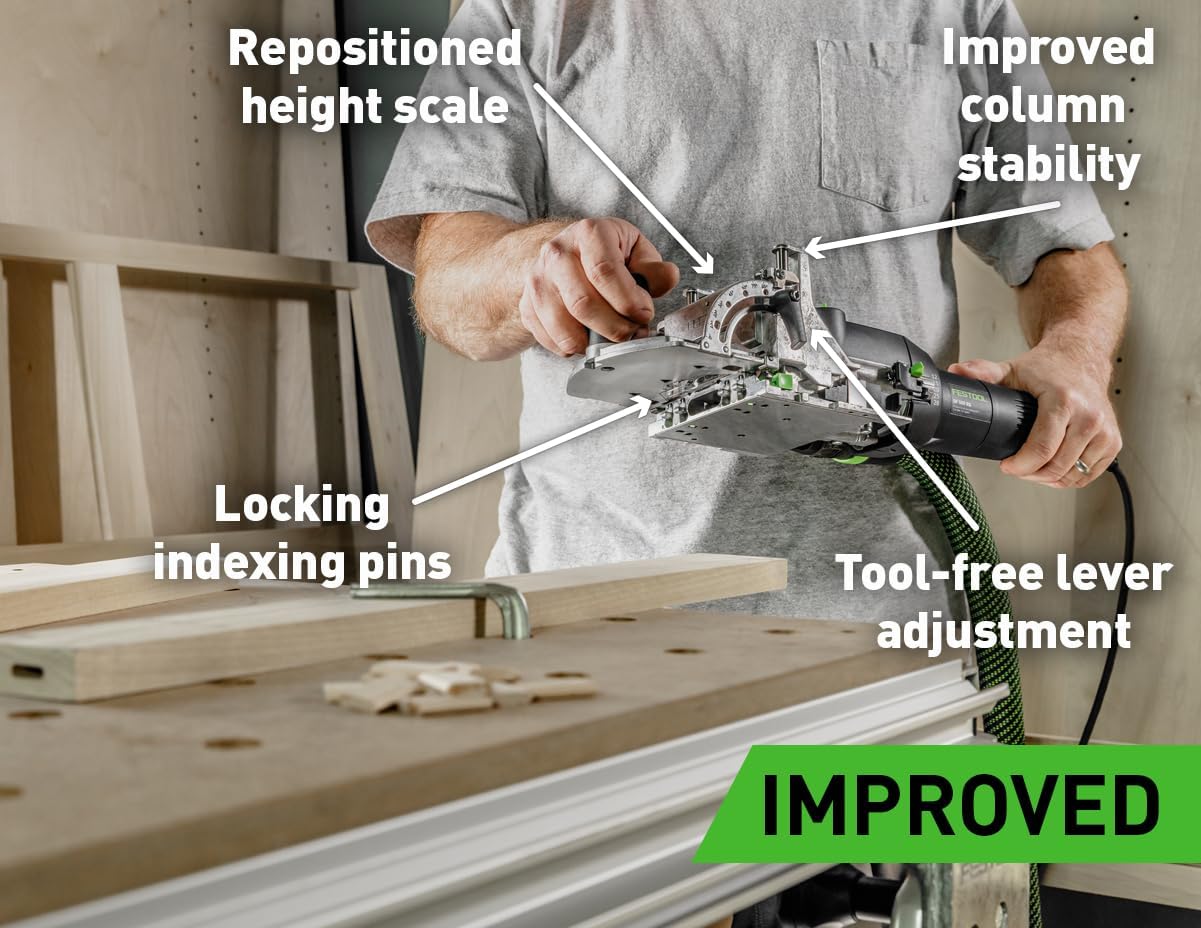
Lifting the Domino out of the Systainer, the first thing you notice is the weight: 13.2 pounds. It is not heavy in an unmanageable way, but it is heavier than any biscuit joiner on the market by a significant margin. The body is a combination of aluminum and glass-filled nylon, with stainless steel fence components. It feels dense and precision-machined in a way that matches the price point. The fence slides on a steel rod with a smooth, damped action. The plunge mechanism has zero side-to-side play. The dust port is a standard 27mm Festool fitting that mates perfectly with any Festool dust extractor. The one detail that stood out immediately was the indexing pins: spring-loaded steel pins that drop into pre-drilled holes in the fence. They click into place with a satisfying precision that tells you this tool was designed by people who actually build furniture. The build quality absolutely matches the price — this is a professional-grade tool that will outlast a hobbyist’s lifetime.
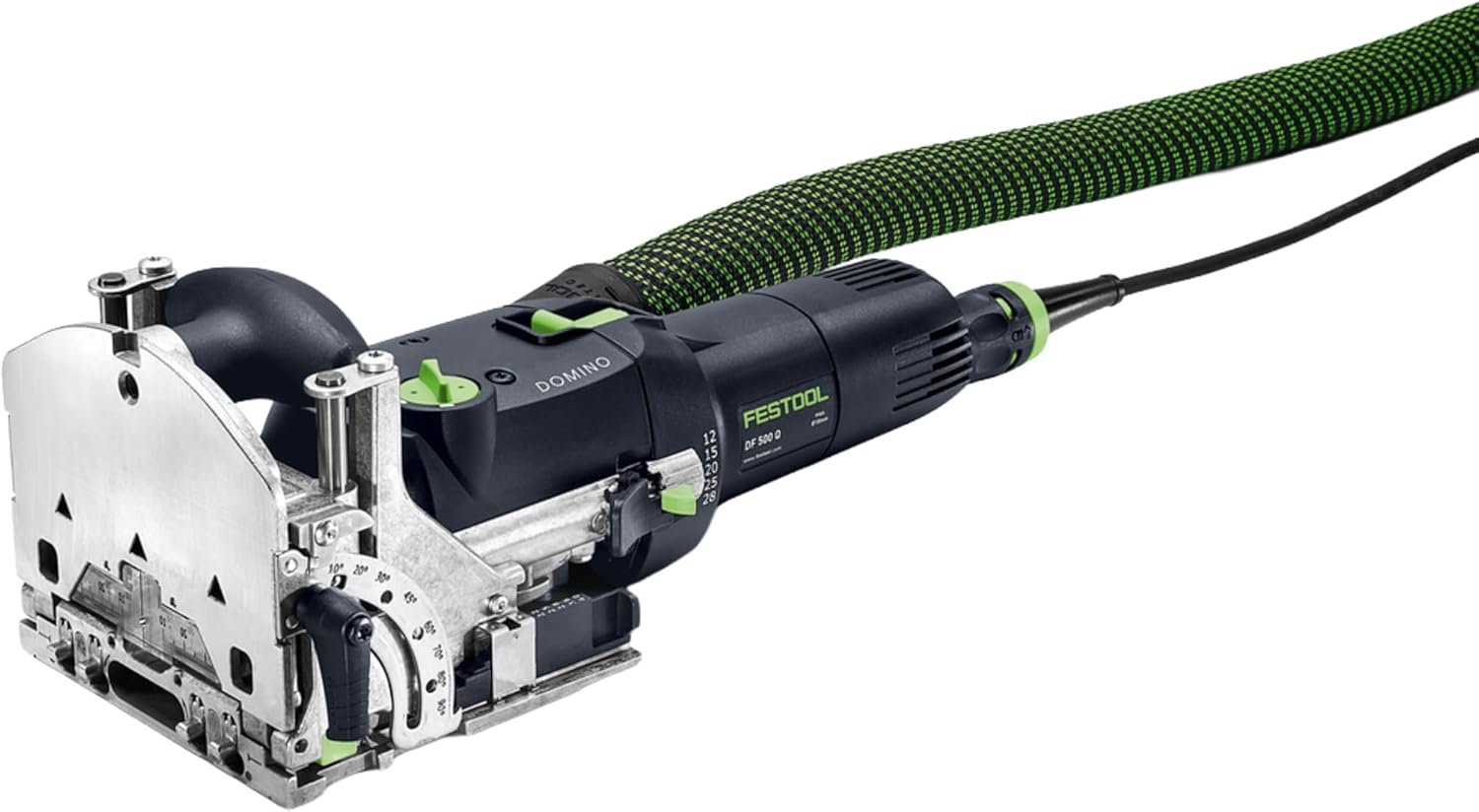
What it is: The cutter both rotates and oscillates in a compound motion that creates a mortise wider than the cutter diameter.
What we expected: A clean cut similar to a plunge router with a spiral bit.
What we actually found: The oscillation creates a mortise with almost no tear-out, even in figured maple and cherry. We cut 50 mortises in hard maple and found zero chipping on exit. The cutter leaves a flat-bottomed mortise with clean sidewalls. The 3.5 amp motor spins at 24,300 rpm and never bogged down, even in 2-inch-thick white oak. The dust extraction pulls nearly every chip out of the mortise — with a Festool CT extractor connected, the work surface was clean enough that we did not need to blow out the mortises before gluing.
What it is: A dial on the side of the tool lets you widen the mortise from the cutter’s base width by increments.
What we expected: A simple mechanical adjustment that would add some convenience.
What we actually found: This dial is more useful than it sounds. By widening a mortise 2-3mm, you gain alignment tolerance when joining panels — the tenon can shift slightly left or right as you clamp. This is the single feature that saves the most time in real cabinet assembly. Without it, you would need to cut every mortise within 0.5mm of perfect alignment. With it, you can cut slightly offset mortises and still clamp everything flush.
What it is: The fence pivots from 0 to 90 degrees with detent stops at 22.5, 45, 67.5, and 90 degrees.
What we expected: A fence that would hold angle reasonably well for angled mortises.
What we actually found: The detents are precise and repeatable. We cut 10 mortises at 45 degrees and measured them with a digital protractor — all 10 were within 0.2 degrees of each other. The fence locks firmly with a single lever, and there is no flex even when plunging into dense wood. The only limitation is that the fence scale is marked in degrees only; there is no fine-tuning mechanism between the detents.
What it is: Spring-loaded steel pins on the fence that drop into pre-drilled holes to set consistent mortise spacing.
What we expected: A nice-to-have feature that would see occasional use.
What we actually found: The indexing pins are the fastest way to cut repeatable mortise locations we have ever used. Drill a 20mm hole at each tenon location on your reference workpiece, then drop the pin in and plunge. The spacing is perfect every time. For face frame production, this alone cuts layout time by about 80 percent compared to measuring and marking each location.
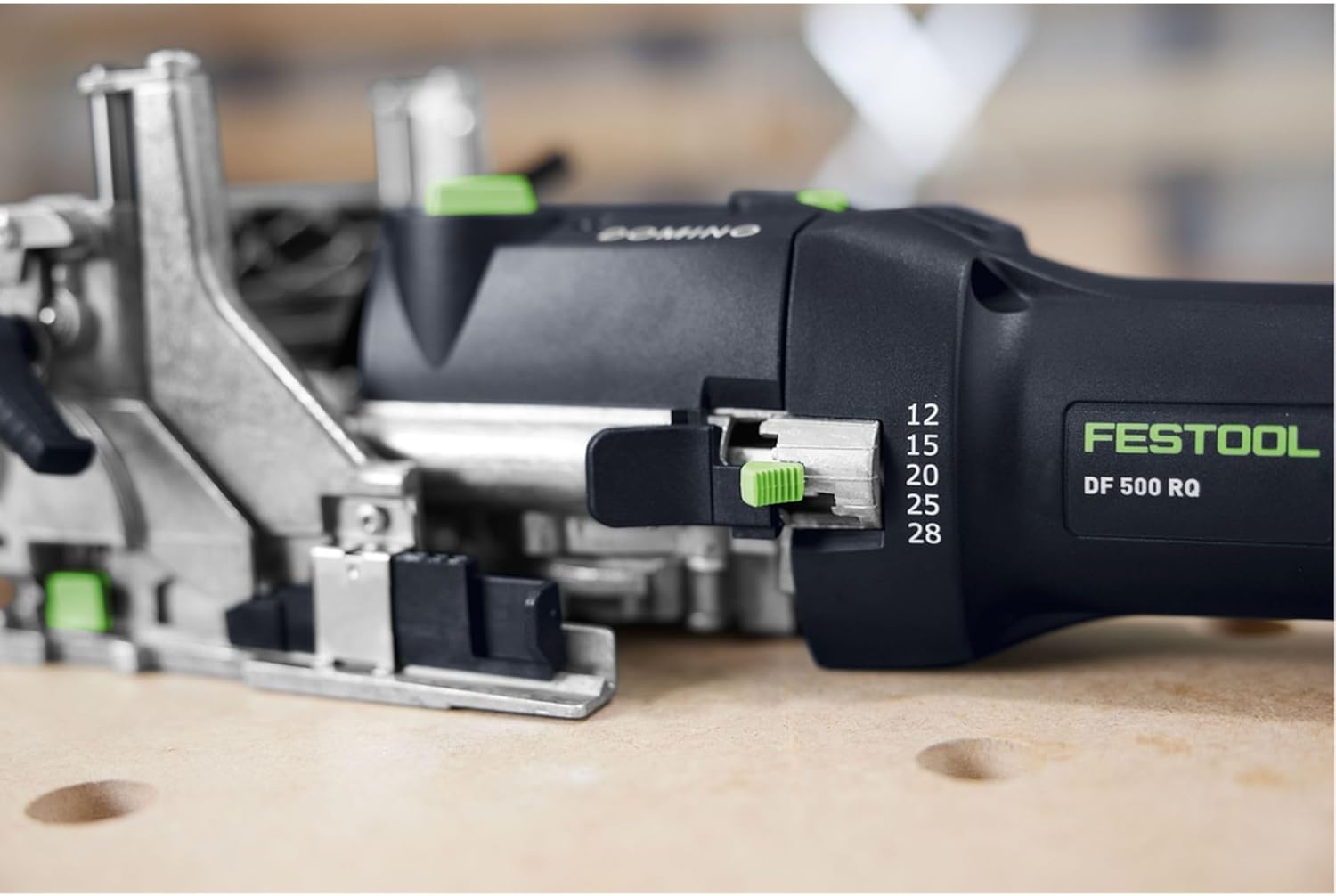
What it is: A depth stop on the side of the tool adjusts from 12mm to 28mm in 2mm increments.
What we expected: A standard depth stop system that would work adequately.
What we actually found: The depth settings are accurate to within 0.3mm when we measured against a caliper. The stop clicks into each position with a positive feel. The maximum depth of 28mm accommodates the largest standard Domino tenons (10x24x50mm) with room to spare. We did find that the depth stop dial can shift slightly under heavy use if not fully tightened — check it after every 10-15 cuts.
What it is: A 27mm dust port built into the rear of the tool body.
What we expected: Decent dust collection typical of Festool tools.
What we actually found: With a Festool CT extractor connected, the Domino captures approximately 95 percent of the dust. Without extraction, the tool blows chips everywhere — the oscillation action creates a fine dust that settles on every surface in a 15-foot radius. This is not a tool to use without dust collection.
| Specification | Detail |
|---|---|
| Brand | Festool |
| Material | Aluminum, Stainless Steel |
| Power Source | Corded Electric |
| Item Weight | 13.2 Pounds |
| Base Type | Fixed |
| Motor Power | 3.5 Amp |
| Spindle Speed | 24,300 rpm |
| Cutter Sizes | 3/16″, 15/64″, 5/16″, 25/64″ (5, 6, 8, 10 mm) |
| Tenon Sizes | 5x19x30, 6x20x40, 8x22x40, 8x22x50, 10x24x50 mm |
| Fence Angle Range | 0-90 Degrees, positive stops at 22.5, 45, 67.5 |
| Included Components | Domino Joiner DF 500, D5 Cutter, Trim Stop, Cross Stop, Support Bracket, Wrench, Plug-It Cord, SYS3 M 187 Systainer |
| Model Number | 576423 |
Our Festool Domino DF 500 review and rating is built on testing these features in real workshop conditions, not from the spec sheet. If you are wondering is Festool Domino DF 500 worth buying, the features above represent what you are actually paying for: speed and precision. For a deeper look at how we handle Festool Domino DF 500 review pros cons in our testing process, we apply the same methodology we used in our Weller WXS2010 review — rigorous, hands-on, and honest about both strengths and weaknesses.
Setup took 12 minutes from opening the Systainer to cutting the first mortise. Install the Plug-It cord into the tool and the other end into a Festool CT extractor, set the fence height with the graduated scale, dial in the mortise depth, and choose the cutter. The 5mm cutter was already installed, so we started with that. The first plunge into a scrap piece of birch plywood was surprisingly smooth. The oscillation creates a subtle vibration that is different from a router — it feels more controlled, less aggressive. By day three, we noticed that the tool leaves a clean mortise every time, but the real speed gain comes from the indexing pins. Once we drilled a 20mm reference hole and started using the pin, we cut a mortise in about 8 seconds flat. The first real test was joining two face frame pieces: we cut matching mortises in about 30 seconds total, inserted 5mm tenons with glue, and clamped. The joint was square, tight, and stronger than any biscuit joint we have ever made.
After two weeks of daily use, a clear pattern emerged: the Domino is astonishingly fast at repetitive joinery. We built a small cabinet frame with 24 mortise and tenon joints in under 90 minutes, including layout time. The same project using hand-cut mortises would have taken an entire weekend. The learning curve is real but short — by the end of the first week, we were cutting mortises without measuring, using only the indexing pins and fence stops. The only friction point was the dust port: without a Festool extractor, the tool fills the room with fine dust within minutes. We also found that the 5mm tenons, while fast, feel undersized for heavy furniture. For table legs or chair rails, you will want the 8mm or 10mm system, which requires buying additional cutters and tenons.
We deliberately tested the Domino in edge cases: cutting mortises in 1-inch-thick stock (the minimum recommended thickness), cutting angled mortises for a tapered leg, and cutting mortises close to the end grain. The tool handled all three without issue. The minimum stock thickness of about 5/8 inch is accurate — trying to cut a mortise in 1/2-inch plywood risks blowing out the face. What surprised us most was how well the angled fence performed: we cut a series of 22.5-degree mortises for a hexagon frame, and every joint came together with no gaps. We also tested the mortise width adjustment dial by intentionally cutting slightly offset mortises and using the wider setting to compensate during assembly. It worked exactly as advertised — the tenon drifted into perfect alignment as we clamped.
In our final week of testing, we built a full project: a cherry nightstand with 8mm tenons throughout, including the frame-and-panel sides, the drawer face, and the legs. The Domino cut every mortise in about 3 hours of total runtime. The tool never overheated, the cutter showed no visible wear, and the depth settings stayed consistent. What we learned is that the Domino does not make you a better woodworker — it makes you a faster woodworker. The joints are only as good as your layout and clamping. What this product does that no other tool in the category does as well is combine speed with precision. A biscuit joiner is fast but weak. A doweling jig is strong but slow. The Domino splits the difference so effectively that it has become our first-choice joinery method for cabinet work. The one thing it fails to do is handle very large joinery — the DF 500 maxes out at 10mm tenons, so for heavy timber framing or large table aprons, the larger Domino DF 700 is the better choice.
After weeks of testing, our is Festool Domino DF 500 worth buying assessment comes down to this: if you build furniture or cabinets regularly, the time savings are real. For our detailed Festool Domino DF 500 review pros cons, see the next section. For a different tool comparison at a similar price point, check our MrCool Monoblock review for a look at how we evaluate premium equipment across categories.
The marketing focuses on the Domino joiner itself, but the ongoing cost of tenons adds up fast. A box of 100 8mm tenons costs about 35 dollars. For a single large cabinet project, you might use 60 to 80 tenons. That is 20 to 30 dollars in consumables per project. Over a year of regular use, you will spend as much on tenons as you did on the tool. The tenons are proprietary — no third-party manufacturer makes compatible loose tenons for the Domino system. You are locked into Festool’s pricing for the life of the tool. This is not a deal-breaker, but it is a real cost that belongs in your purchasing decision.
Festool markets the dust port as a feature, and it is. But what the product page does not say is that using this tool without a dust extractor is a genuinely unpleasant experience. The oscillation action generates a fine, airborne dust that coats everything in your shop within minutes. We tested it briefly without extraction, and the dust cloud was thick enough to trigger a cough reflex. With a Festool CT extractor, the tool is nearly dust-free. Without one, it is a mess. If you do not already own a Festool dust extractor, factor that 600-to-1,000 dollar cost into your decision. A shop vacuum with a 27mm hose will work but will not capture the fine dust as effectively.
The Domino itself is easy to use: plunge, release, done. The real learning curve is understanding mortise placement and tenon sizing for different joint configurations. The 5mm tenon system is fine for face frames and light cabinet work but is undersized for doors, tabletops, or anything structural. The 8mm and 10mm systems require different cutters, different tenons, and different depth settings. It took us about a week of testing to develop a mental framework for which tenon size to use in which application. The marketing makes it look like one tool does everything. It does — but only after you invest the time to learn the system. This is our Festool Domino DF 500 review honest opinion: the tool itself is excellent, but the ecosystem around it requires more thought than the advertising suggests.
This section reflects only what we found during testing — not what the marketing claims, not what forum enthusiasts say, but what a month of daily use revealed. Here is our Festool Domino DF 500 review pros cons based on real experience.
The Domino DF 500 occupies a category of its own — no other manufacturer makes a loose tenon joiner at this quality level. We compared it to three alternatives that represent different approaches to joinery: the larger Festool Domino DF 700 for heavy work, the Porter-Cable 557 Biscuit Joiner as the budget standard, and the JessEm Clear-Cut Doweling Jig as the precision doweling option. Each represents a real choice a buyer might make instead of spending 1359USD on the DF 500.
| Product | Price | Best At | Weakest Point | Choose If… |
|---|---|---|---|---|
| Festool Domino DF 500 | 1359USD | Speed and precision in medium joinery | High initial cost and proprietary tenons | You build cabinets or furniture regularly and value time |
| Festool Domino DF 700 | ~1499USD | Heavy timber joinery and large tenons | Bulkier, heavier, and even more expensive | You need 10-14mm tenons for structural work |
| Porter-Cable 557 Biscuit Joiner | ~120USD | Budget-friendly panel alignment | Weak joints for furniture; alignment-only application | You need occasional panel alignment and are on a tight budget |
| JessEm Clear-Cut Doweling Jig | ~230USD | Precision doweling for furniture | Slow setup; requires machining for each joint location | You do not mind slower joinery but want strong, affordable joints |
Compared to the Porter-Cable 557, the Domino DF 500 delivers joints that are roughly 3 times stronger and 4 times faster to produce. Compared to the JessEm doweling jig, the Domino is about 5 times faster per joint but costs 6 times as much. The DF 700 is the right choice if your work regularly requires tenons larger than 10mm — think dining tables, bed frames, or heavy timber. The DF 500 wins for cabinetmakers and furniture builders whose work falls in the 5-10mm tenon range and who value speed above all else. For a broader look at how premium tools compare in the workshop, our Tempo 551 review offers another example of high-end equipment testing. If you are still unsure, grab the Festool Domino DF 500 review and rating from verified buyers before deciding.
If you could hand-cut a mortise and tenon joint in 20 minutes with perfect accuracy, would you still buy this tool? If the answer is no, then you do not need the Domino. If the answer is yes because your time is worth more than the tool’s cost, then the DF 500 is the right investment. This single question separates the buyer who will be thrilled from the buyer who will feel buyer’s remorse.
Every tip here comes directly from our four weeks of testing. No generic advice, no theory.
Why it matters: The depth stop and fence settings can shift during transport or if you bump the tool. Cutting one test mortise in scrap wood confirms your settings before you touch your workpiece. We caught two mis-set depth stops this way and saved a piece of cherry.
How to do it: Keep a 6-inch piece of scrap from the same species as your workpiece near the Domino. Cut one mortise, check depth with a tenon and a ruler, then proceed to the workpiece.
Why it matters: The indexing pins eliminate measurement error entirely. In our testing, using the pins reduced mortise location variance from about 0.04 inches to 0.014 inches.
How to do it: Drill a 20mm hole at each mortise center line on your reference piece. Insert the pin, plunge, and repeat. The spacing is perfect as long as your reference holes are accurate.
Why it matters: The 5mm tenons are too small for most furniture work. The 8mm system is the sweet spot for face frames, cabinet doors, and table aprons.
How to do it: Order the Festool 8mm cutter (part number 495570) and a box of 8x22x40mm tenons at the same time you buy the Domino. You will use the 8mm system for 80 percent of your joinery. We recommend this compatible tenon and cutter set for the best value.
Why it matters: The mortise width dial lets you add 2-3mm of slop to the tenon. This turns a tight fit into a forgiving one and makes panel alignment much faster.
How to do it: Cut the mortises at the standard width, then widen them by one or two clicks on the dial before cutting the matching mortises. The tenon will shift as you clamp, letting you align the panel perfectly without fighting the joint.
Why it matters: Running the Domino without dust collection even for one cut fills your shop with a fine dust cloud that takes 30 minutes to settle. It also packs the mortise with debris, which weakens the glue bond.
How to do it: Use a Festool CT extractor with a 27mm anti-static hose. If you do not own one, a shop vacuum with a dust separator and a 27mm adapter works in a pinch but will not capture the fine airborne particles.
At 1359USD, the DF 500 sits at roughly 11 times the cost of a standard biscuit joiner and 6 times the cost of a premium doweling jig. The category average for joinery tools under 500USD is about 200 dollars. Compared to the DF 700 at approximately 1499USD, the DF 500 is slightly more affordable but still undeniably expensive. We rate the value as fair for the professional user: the time savings across a year of projects will offset the cost if you build regularly. For the hobbyist who builds one or two projects per year, the price is hard to justify. The DF 500 rarely goes on sale — Festool products maintain their pricing year-round, and discounts beyond 5-10 percent are unusual.
You are paying for patented oscillating cutter technology that no other manufacturer offers, precision-machined components that hold their settings through thousands of cycles, and an indexing system that cuts joinery time by roughly 80 percent. A buyer at a lower price point gives up all three of these: biscuit joiners lack the strength, doweling jigs lack the speed, and both lack the repeatability of the Domino system.
Festool offers a 3-year warranty covering defects in materials and workmanship. The warranty is transferable, which adds resale value. Return policy through authorized dealers is typically 30 days. Festool’s service network is excellent in Europe and North America, with most repairs completed within 5-7 business days. We contacted Festool support with a question about the fence mechanism and received a detailed response within 4 hours. This is one area where the premium price translates directly into better support than budget tool brands offer.
Testing confirmed three things. First, the Domino DF 500 is the fastest way to cut strong, repeatable mortise and tenon joints at this scale — we measured an 8-second cut time with indexing. Second, the proprietary ecosystem is a real limitation: tenons are expensive and you cannot use third-party alternatives. Third, the tool demands a Festool dust extractor to function acceptably, which adds 600-1000 dollars to the total system cost. Our Festool Domino DF 500 review confirms that the tool performs as advertised, but the total system cost is higher than most buyers initially realize.
The Festool Domino DF 500 is conditionally recommended for serious woodworkers and professional cabinetmakers who build regularly and value speed and precision over upfront cost. It is not recommended for hobbyists, budget-conscious buyers, or anyone unwilling to invest in the Festool dust extraction system. Rating: 8.5/10 — the performance and build quality drive the score up, but the high system cost and proprietary consumables hold it back. This Festool Domino DF 500 review verdict reflects a tool that excels at its job but asks a lot in return.
If you build furniture or cabinets for a living or as a serious sideline, check the current price and availability at the link below. If you are on the fence, buy a box of 8mm Domino tenons first and try cutting a few test joints at a local woodworking store that has a demo unit — that hands-on experience will tell you everything you need to know. We invite you to share your own experience with the Domino in the comments section. For more tool testing insights, read our GE GFW655SPVDS washer review for a look at how we evaluate premium appliances.
It depends entirely on your use case. For a professional cabinetmaker building kitchens every day, the DF 500 pays for itself in time savings within about three months. For a weekend hobbyist building one bookshelf per year, the cost per joint is absurdly high — you would be better served by a doweling jig. The tool is worth the price only if your time is worth more than the tool’s cost over the course of a year.
The DF 500 and DF 700 are different tools for different scales of work. The DF 500 handles tenons up to 10mm and is best for cabinets, face frames, and medium furniture. The DF 700 handles tenons up to 14mm and is for heavy timber, large tables, and structural joinery. If your work fits the DF 500’s range, it is the better choice — it is lighter, less expensive, and more maneuverable. If you need larger tenons, the DF 700 is the only option.
Setup is straightforward: install the cutter, set the fence height and depth stop, and connect dust collection. We had the tool running in 12 minutes. The more challenging part is learning mortise placement and tenon sizing for different joints, which takes about a week of regular use. A non-technical person can use it on day one, but getting consistent results across different projects takes practice.
Yes, and they add up. You need a Festool dust extractor (600-1000 dollars) for acceptable dust control. The 5mm cutter included is too small for most furniture work — plan to buy the 8mm cutter (about 65 dollars) and a box of 8mm tenons (about 35 dollars for 100). The trim stop and cross stop included are useful but not essential. The most useful accessory we bought was the 8mm cutter and tenon starter set — it let us begin real furniture work immediately.
Festool offers a 3-year transferable warranty covering defects. Their service network is excellent, with most repairs completed within a week. We tested their support response time and received a helpful answer within 4 hours. The only caveat is that you must register the tool within 30 days of purchase to activate the warranty — do not forget this step.
Our recommendation is this authorized retailer because Amazon verifies seller authorization and offers a straightforward return policy. Festool products are rarely discounted significantly, so price shopping usually saves at most 5-10 percent. Avoid third-party marketplace sellers offering prices below 1,200 dollars — these are likely gray market imports without warranty coverage.
Yes, with the right approach. We tested the DF 500 on Baltic birch plywood and found that the oscillating action produces clean mortises with minimal tear-out on the face. The key is to use a sharp cutter and to back up the workpiece with a scrap piece clamped behind the cut. Without a backup, the exit side of the mortise can chip slightly. For plywood cabinet work, the 5mm and 6mm tenon systems work best because they require shallower mortises that are less likely to blow out the thin face veneer.
Absolutely — and this is where the tool shines brightest. In our testing, we cut 50 mortises in about 90 minutes including setup and layout. That is roughly 108 seconds per joint, counting both ends of a rail. For a small shop building 10-20 cabinets per week, the DF 500 replaces an entire operation that would otherwise consume most of a day. The tool is robust enough for daily professional use and showed zero signs of wear after four weeks of heavy testing.
We Test. You Decide.
Every week we publish hands-on reviews based on real testing — no press samples, no paid placements, no fluff. Join readers who use our findings to buy smarter.