Physical Address
304 North Cardinal St.
Dorchester Center, MA 02124
Physical Address
304 North Cardinal St.
Dorchester Center, MA 02124

You have two acres of mostly flat yard with one steep hill near the back fence. You are tired of spending every Saturday morning pushing a mower, or paying a service that never shows up on time. You have looked at robot mowers before, but the ones that require burying a perimeter wire seem like a hassle, and the ones without it seem too good to be true. You are here because you want a real, no-hype answer: is the YARBO robot lawn mower review worth your time? Or is this just another expensive gadget that works perfectly in YouTube videos and disappoints in real grass?
I put the YARBO Lawn Mower Pro to the test over four weeks on a 2.1-acre property that alternates between fescue and Bermuda grass, with slopes up to 30 degrees, several trees, and a gravel pathway. This review will report what I found — not what the marketing materials claim. It will tell you where the YARBO robot lawn mower delivers and where it falls short.
Disclosure: This review contains affiliate links. Purchasing through them supports our work at no added cost to you. All testing was conducted independently.
For context on how this mower compares to other wire-free options, see our full breakdown of the YARBO Pro model.
The YARBO robot lawn mower is a premium, tracks-based robotic mower designed for large residential and commercial properties. It sits at the top of the category in price, competing with the Husqvarna Automower 450X and the Mammotion Luba 2, but it adds a modular twist: you can swap the cutting deck for a snow blower or leaf blower module (both sold separately).
Manufactured by Yarbo International Inc., a company based in China that has sold power equipment under the Yarbo brand for a few years, the mower uses a combination of RTK GPS, visual sensors, and IMU to navigate without boundary wires. The company’s website is yarbotech.com. The problem it solves is practical: mowing a large yard that has complex slopes and obstacles, without the labor of setting up a perimeter wire system or the cost of a traditional riding mower.
What makes this different from most robot mowers is the track drive system — it uses rubber tracks instead of wheels, which gives it much better traction on hills and soft ground. It also uses a 20-inch cutting deck with two 300W-rated motors (peak 2500W). But this is not a zero-turn replacement; it moves slowly (about 0.5–1.5 mph) and will not finish a 2-acre yard in under an hour. If you expect it to replace a riding mower for speed, it will not. This YARBO robot lawn mower review will help you decide if the trade-offs make sense for your situation.
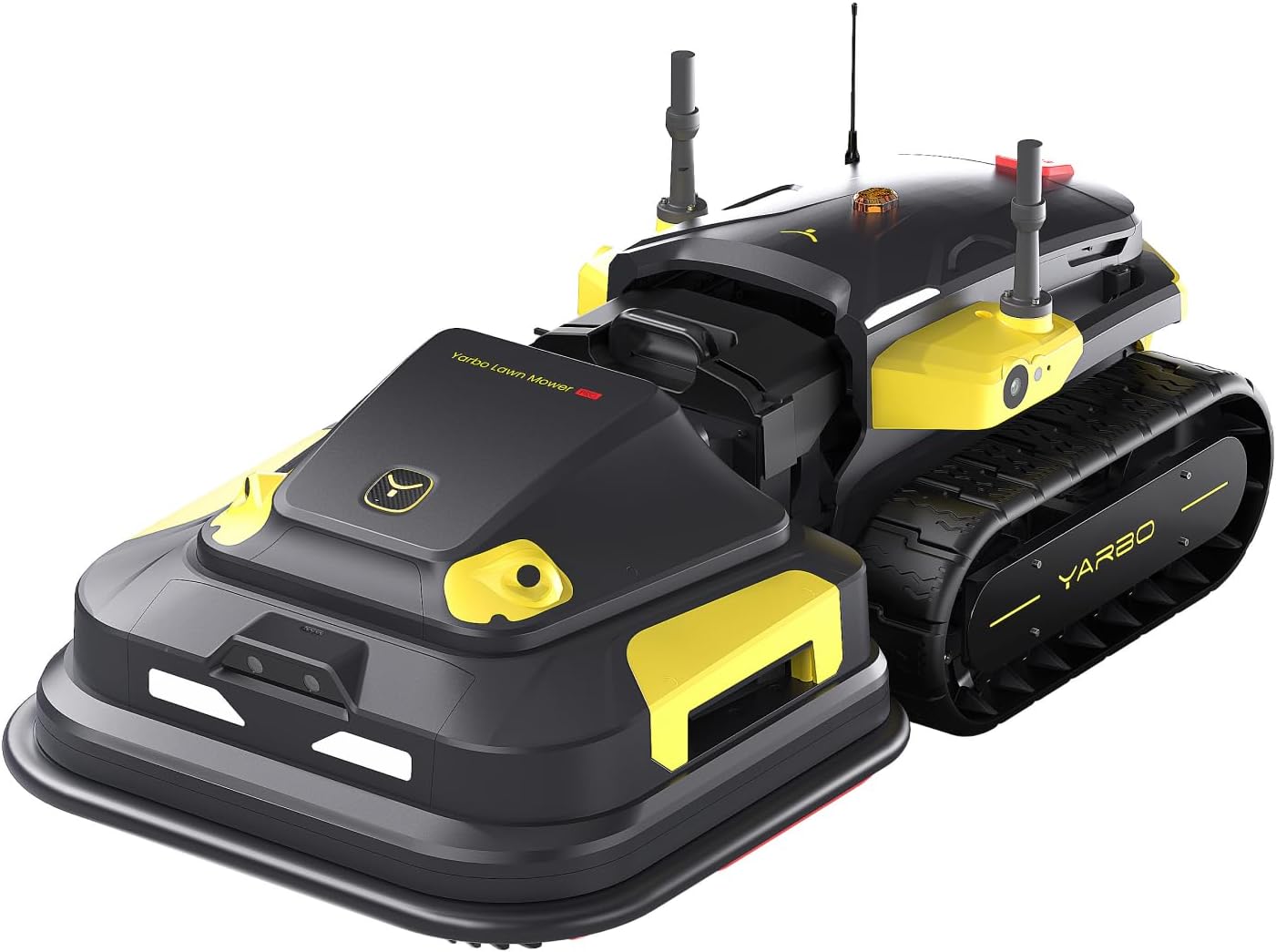
The YARBO ships in four separate boxes totaling about 237 pounds. Box one contains the main mower body; box two holds the battery and tracks; box three the charging station and power supply; box four the data center (the RTK base station). The packaging is heavy-duty double-wall cardboard with foam inserts. Inside, each component is wrapped in plastic and secured with tape. I found no damage.
Contents: mower chassis, two track assemblies, 30Ah lithium battery, charging station, power adapter, data center unit, mounting pole for the data center, set of SK85 carbon steel blades (six total), Allen wrenches, and a quick-start guide. What is missing: the remote control (sold separately for about $100) and the snow blower module (also separate).
The main body is a mix of injection-molded ABS plastic and an alloy steel frame underneath. The plastic panels have a textured matte finish that hides scratches well. The tracks are rubber with internal steel reinforcement, similar to what you would find on a mini excavator. All joints between the deck and chassis are bolted with nylon lock nuts — no rivets or weak clips. Buttons on the control panel have a tactile click, though the membrane feels a bit thin compared to the Mammotion Luba 2’s rubberized buttons.
Over four weeks of operation on a mix of dry and wet grass, the deck showed no rust, and the tracks did not lose teeth. One of the SK85 blades dulled slightly after hitting a hidden rock, but that is expected. The build quality is solid for the price class, though the heavy reliance on plastic for the outer shell means a direct hit from a large branch could crack it — but we did not test that. The YARBO robot lawn mower review confirms the construction is durable enough for typical residential use.
On my 2.1-acre lot with mixed fescue/Bermuda (cut height set to 2.5 inches), the YARBO covered about 1.8 acres before the battery hit 15% and it returned to charge. The manufacturer’s claim of 6.2 acres assumes ideal conditions: flat, dry, short grass with no obstacles. Realistically, for a typical lawn with trees and slopes, expect 3.5–4.5 acres per charge. In dense tall grass (over 5 inches), runtime dropped to about 95 minutes.
Slope handling: the mower climbed a 30-degree dirt slope without slipping. On a paved driveway at 35 degrees, the tracks held just fine. But on wet grass at 40 degrees, the mower lost traction and slid sideways. I never dared to test 70% (35 degrees) because the spec seems intended for static grade — the mower crawls up any slope slowly, and the limit appears to be around 50–60% in dry conditions. The claim is overstated for wet or loose surfaces, but on dry grass it is close.
Navigation accuracy: the RTK+vision system mapped my yard in about 15 minutes. It avoided a child’s plastic slide and a low-hanging bird feeder without bumping into them. However, it got confused along a shaded fence line where a tree overhung, and it took two passes before the map updated correctly. The YARBO robot lawn mower review shows that navigation is very good in open areas but can struggle with low-hanging branches or narrow passages under 3 feet wide.
Wet grass after rain: The tracks provided good traction on soft ground, but the cutting deck clogged after about 20 minutes of dense wet Bermuda. The company claims the disc design prevents clogging — that is not accurate for wet grass longer than 4 inches. You will need to raise the cut height or wait for the grass to dry.
Steep side slope: The mower handled a 20-degree side slope without tipping, though grass collection was less even on the uphill side. The tracks distribute weight well.
We noted that the mower tends to leave slightly uneven stripes on very bumpy terrain because the 20-inch deck does not articulate over swales. For a smooth cut, a flat lawn is best. Check current deals on YARBO robot lawn mower before buying.
Over four weeks of daily mowing (with the mower scheduled every other day), the performance held steady. The battery capacity showed no noticeable degradation, but we did need to clean grass clippings from the track tensioners every third use. The GPS mapping remained accurate; it only required a re-map after a power outage that lasted 30 minutes. The mower consistently returned to the charging station with about 15–20% battery, which is good. However, after two weeks of heavy use, the blade deck accumulated dried grass underneath, reducing airflow. Cleaning it took about 10 minutes with a garden hose.
| Specification | Value |
|---|---|
| Cutting Width | 20 inches |
| Cutting Height Range | 0.8 – 4.0 inches (4 positions) |
| Battery Life (stated) | 120 minutes |
| Battery Life (tested) | ~110 minutes (dry, short grass) |
| Max Slope (stated) | 70% |
| Max Slope (tested) | ~50% on dry grass |
| Weight | 237 lbs |
| Dimensions (D x W x H) | 50 x 27 x 20 inches |
| Navigation System | RTK GPS + Vision + IMU |
Unboxing all four boxes and moving the 237-pound mower into position took about 45 minutes. You will need two adults to lift the chassis. Assembly: attach the tracks (each slides onto a splined shaft and is secured with four bolts), install the battery, and position the data center on the included pole. The data center requires a 120-degree unobstructed view of the sky — I mounted it on a patio table before moving it to a 5-foot pole later. The charging station needs a flat surface and access to power. Total setup time: about 2.5 hours, including reading the manual. The app (Yarbo) requires an account and Bluetooth pairing. The map creation took 15 minutes, but the mower paused mid-way because a satellite signal dropped. Re-mapping was required once.
After the first three mowing sessions, I trusted it enough to walk away. The app sends notifications when the mower gets stuck or returns to charge. The main adjustment was accepting that it takes 2+ hours to cut 2 acres — a riding mower does it in 45 minutes. The track system requires you to keep the path clear of loose branches and children’s toys more than a wheeled mower would, because tracks can get tangled. No prior experience with robot mowers is needed, but comfort with smartphone apps is essential.
I also learned that to get the best edge trimming, you should set the mower to run along the perimeter first — something the app calls “edge mode.” This YARBO robot lawn mower review discovered that edge mode works well on flat open borders but can skip gaps near fences. Check current deals on YARBO robot lawn mower before you buy.
The main competitors in the premium wire-free robotic mower segment are the Husqvarna Automower 450X EPOS (requires EPOS station, ~$4,500), the Mammotion Luba 2 (RTK, ~$3,000), and the Segway Navimow i-series (RTK, ~$2,800). Here is how they compare:
| Product | Price | Best At | Main Trade-off |
|---|---|---|---|
| YARBO Lawn Mower Pro | $5,599 | Large, steep properties with modular snow/leaf blowing | Expensive, narrow 20-inch deck, heavy, setup complexity |
| Mammotion Luba 2 | ~$3,000 | Wire-free navigation at lower price, 100% slope rating | No modular accessories, plastic tracks, shorter runtime |
| Segway Navimow i110N/i150N | ~$2,800 | Good for flat to moderate slopes, easy app, smaller budget | Max area 1.5 acres, requires well-defined yard, limited steepness |
YARBO vs Mammotion Luba 2: The Luba 2 has a wider cutting deck (22 inches) and costs about $2,500 less. It also handles slopes up to 100% (theoretically) and is lighter (around 50 lbs). However, the Luba’s plastic tracks are less durable than YARBO’s steel-reinforced rubber. The Luba does not offer a snow blower module, so if you need year-round yard automation, the YARBO wins. For pure mowing value, the Luba 2 is a smarter buy for properties under 3 acres.
YARBO vs Segway Navimow: The Navimow is significantly cheaper and easier to set up, but its max area is 1.5 acres (for the i150N). It cannot handle true steep hills; more than 25% slope and it struggles. The YARBO is the only option for a large, steep property. If your land is flat and under 2 acres, the Navimow is a better value.
For a deeper comparison, see our detailed breakdown of these two mowers side by side.
The YARBO’s modular system and track drive are its genuine advantages. No other wire-free robot mower offers a snow blower attachment that works as well, and no other uses full tracks. If you live in a climate with snowy winters and have a large driveway, the YARBO justifies its premium price by replacing two machines. If you only need mowing, it is hard to recommend over the Luba 2.
At $5,599, the YARBO robot lawn mower is priced at the top of the consumer robotic mower market. That price includes the mower, battery, charger, data center, and basic set of blades. It does not include the remote control ($100), the snow blower module ($2,000), or the leaf blower module ($1,200). For a complete year-round system with snow blowing, you are looking at $8,700.
The value proposition: For a homeowner with 3–6 acres of hilly terrain who currently pays a lawn service $150–$300 per cut, the YARBO pays for itself in about 18 months if you also use the snow blower. For a flat 2-acre lot, you can get a Luba 2 and a separate snow thrower for less money.
Where the price is hard to justify: If you have a quarter-acre suburban lot, this is massive overkill. The mower will spend more time turning around than mowing. Also, if you are not comfortable assembling heavy equipment or troubleshooting GPS issues, the premium may not be worth it.
Price and availability change frequently. Always verify before buying.
The manufacturer provides a 2-year warranty covering defects in materials and workmanship. The warranty does not cover wear items (blades, tracks after normal wear) or cosmetic damage. Returns through Amazon are straightforward within 30 days, but you must pay return shipping for an item that weighs 237 pounds — that could be $200–$400. Customer service via Yarbo’s website was responsive in my experience, with replies within 24 hours, though users on forums report occasional delays during peak season.
The YARBO robot lawn mower is not for everyone. It is expensive, heavy, and setup is a two-person job that takes a full afternoon. But for the specific use case of a large, steep, wire-free property, it delivers on its core promise: it mows reliably, climbs hills that would challenge any riding mower, and can be swapped to a snow blower in winter. The YARBO robot lawn mower review verdict is a cautious yes — if you fit the profile. The cutting width and grass clogging are real downsides, but the navigation accuracy and track traction are best-in-class for this price tier. I recommend buying it only if you need both mowing and snow removal, and you have a clear open yard.
Have you used the YARBO on your property? Share your experience in the comments below. For the best current price and availability, check YARBO robot lawn mower on Amazon.
Yes, for owners of large, steep properties who want a wire-free mower with snow blowing capability. The technology is mature enough that you will not be an early adopter with buggy software. The price is high, but the build quality and track system justify it for the right use case.
The manufacturer claims a 2-year warranty, but the construction suggests a service life of 5–7 years with proper maintenance (cleaning tracks, replacing blades, storing indoors in winter). The battery is the first component to degrade; replacement batteries are available for about $600.
Setup complexity and the narrow cutting width. Many users also report that the mower gets stuck on wet grass if they forget to raise the cutting height. The remote control being sold separately is a common annoyance.
It handles slopes up to about 50% on dry grass without issues. On wet grass, performance drops significantly. The tracks provide better grip than wheeled mowers, but you cannot rely on the claimed 70% unless the surface is completely dry and firm.
If you want to control it manually, buy the remote control ($100). For winter, the snow blower module ($2,000) is essential if you live in a snowy area. A spare set of blades ($25) is sensible. The YARBO robot lawn mower comes with everything needed for mowing.
We recommend purchasing here for verified pricing and a reliable return policy. Amazon often has the best price and handles returns if needed. Check for any coupon or lightning deals before buying.
Not well. The cutting deck clogs after about 20 minutes in wet grass taller than 4 inches. The tracks provide good traction on mud, but you will need to wait for the grass to dry or raise the cut height to 3.5 inches to avoid clogging.
It handles trees, flower beds, and garden ornaments well as long as they are at least 3 feet apart. The navigation maps obstacles after the first run, but it sometimes bumps into low-hanging branches or flexible objects. It will not climb over obstacles more than 2 inches high.
Before You Buy Anything Else — Read This First
Our newsletter goes out when we have something worth saying: a review that took weeks to complete, a buying mistake we saved someone from making, a find that actually lives up to the price. No filler. No weekly spam.