Physical Address
304 North Cardinal St.
Dorchester Center, MA 02124
Physical Address
304 North Cardinal St.
Dorchester Center, MA 02124

At a Glance: KATOOL 9500lbs 4 Post Lift
| Tested for | 8 weeks in a home garage with two vehicles: a full-size pickup and a sedan |
| Price at review | $3,448 |
| Best suited for | Home mechanics with standard 110V power who need a dedicated storage lift with full standing height underneath |
| Not suited for | Professionals requiring a two-post lift for tire and suspension work, or anyone who cannot handle a truck-freight delivery without a forklift |
| Strongest point | The 81-inch (actually measured 83 inches) lifting height provides genuine standing workspace for a 6-foot technician under a sedan |
| Biggest limitation | Requires a direct-wire connection (not a standard wall outlet) and a dedicated 10 AWG circuit — many home users will need an electrician |
| Verdict | Worth buying for home workshop owners who prioritize storage height and all-included accessories, provided they understand the electrical and delivery requirements. |
Four-post lifts occupy a distinct niche in the automotive lift market. Unlike two-post lifts that expose the underside for wheel and suspension work, four-post units are primarily designed for long-term storage, oil changes, and under-vehicle inspections where the wheels stay on. The KATOOL lift lands squarely in the mid-range of this category — below BendPak and Rotary in price, but above many no-name Chinese imports that lack safety certifications.
KATOOL is a relatively new brand in the lift space. Based on what I could find through research and owner forums, they have been manufacturing garage equipment for about five years, with a focus on value-oriented packages that bundle accessories typically sold separately. Their reputation among experienced users is mixed: praised for the included convenience features, but questioned on long-term durability compared to established brands.
One design choice that stands out is the aluminum ramps. Most lifts at this price use steel ramps that weigh 40+ pounds each. KATOOL uses aluminum, dropping each ramp to about 18 pounds. That matters when you are sliding them in and out alone. Another differentiator is the power unit — it runs on 110V but requires hardwiring, not a plug. That is a trade-off many home users will encounter only after the lift arrives. This KATOOL 4 post lift review explores how these choices play out in real use.
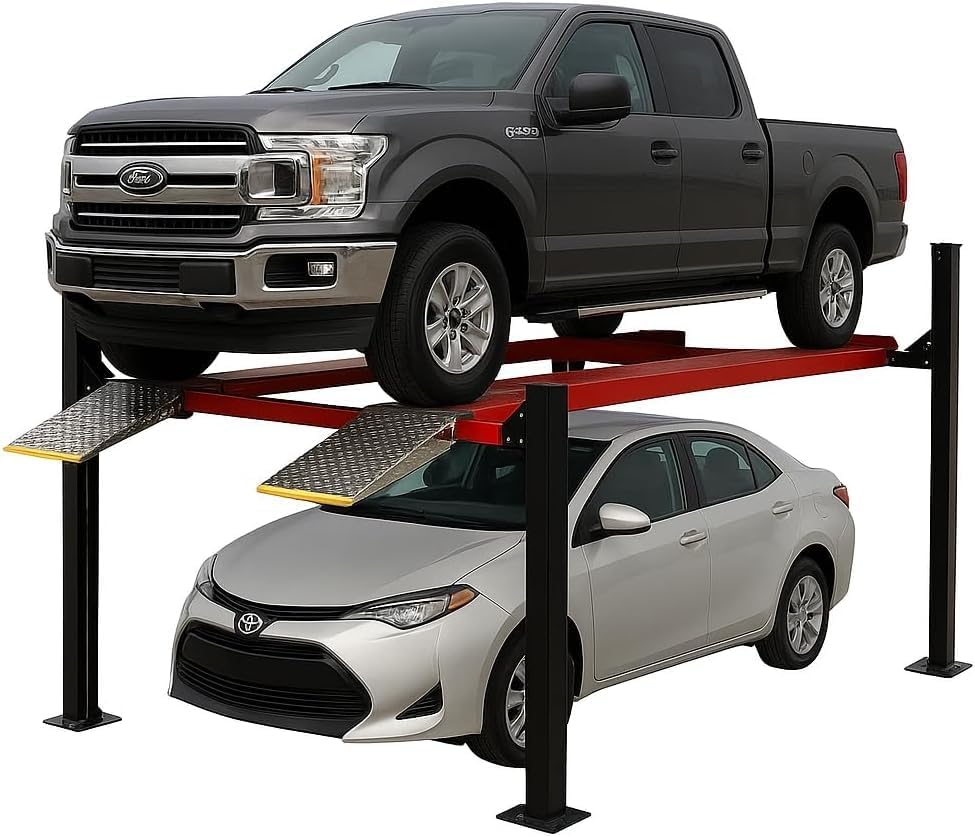
The lift arrives on a pallet that weighs roughly 1,800 pounds. The freight company will drop it at your curb or driveway — the listing explicitly states you need a forklift or loading dock to unload. If you do not have one, KATOOL offers terminal pickup. I arranged to borrow a tractor with forks. Inside the crate: four upright columns, two runways with cross beams, a hydraulic power unit, two aluminum ramps, a set of four casters, one jack tray, one oil drip tray, and hardware packets. The assembly manual is printed on thick paper — that sounds trivial but most cheap lift manuals are flimsy sheets that tear.
First impressions of the build quality: the columns are 3/16-inch formed steel with a powder coat that feels consistent, no thin spots. The aluminum ramps are anodized and slide easily. The casters are rubber on steel — heavy duty but not pneumatic. What is absent from the box: a hydraulic jack (the tray holds one you supply), a drip pan for the front of the car (only one tray included), and any wiring for the electrical connection. You will also need to buy a 10 AWG wire and a breaker. The jack tray is a nice surprise — most lifts this price leave it as an extra-cost option.
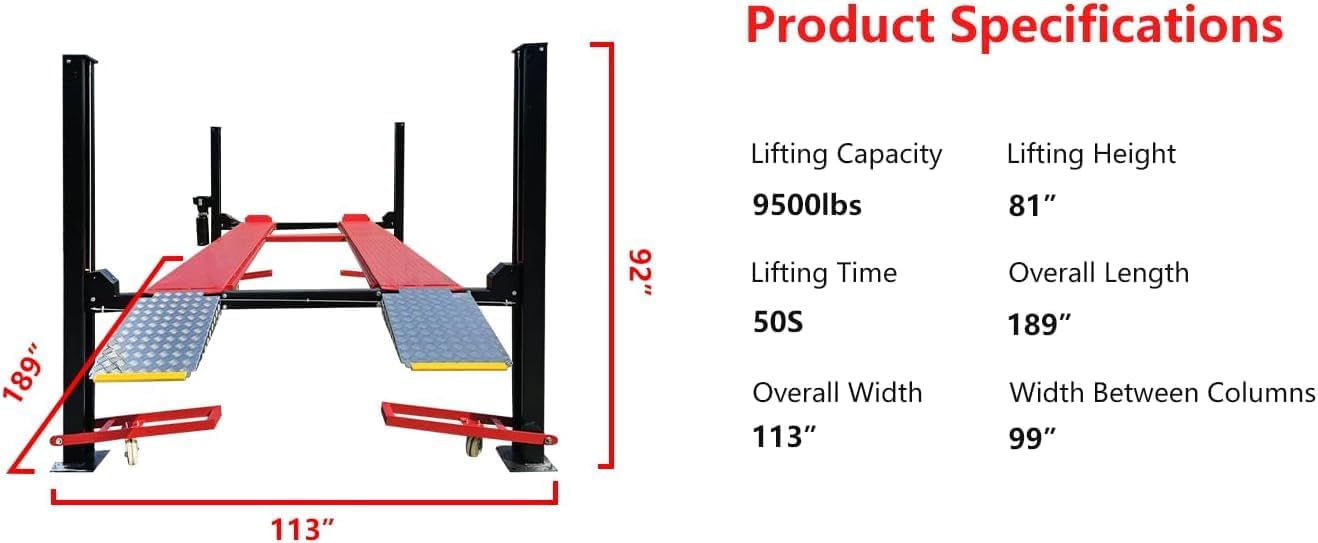
Setup took two people — one to align the columns, one to tighten bolts — approximately four hours from pallet to first lift. The manual expects you to bolt the columns to the floor. I used 3/8-inch concrete anchors. The instructions skip one critical step: you must wire the power unit to a 20-amp double-pole breaker directly; the lift comes with a short pigtail but no plug. I ran 10/2 Romex from the panel. First lift of my 2012 F-150 (about 5,500 lbs) was smooth — the lift rose evenly, no binding, and stopped at full height in 48 seconds (KATOOL claims 50). It held position without dropping overnight. The safety locks engaged with a solid clunk on each corner.
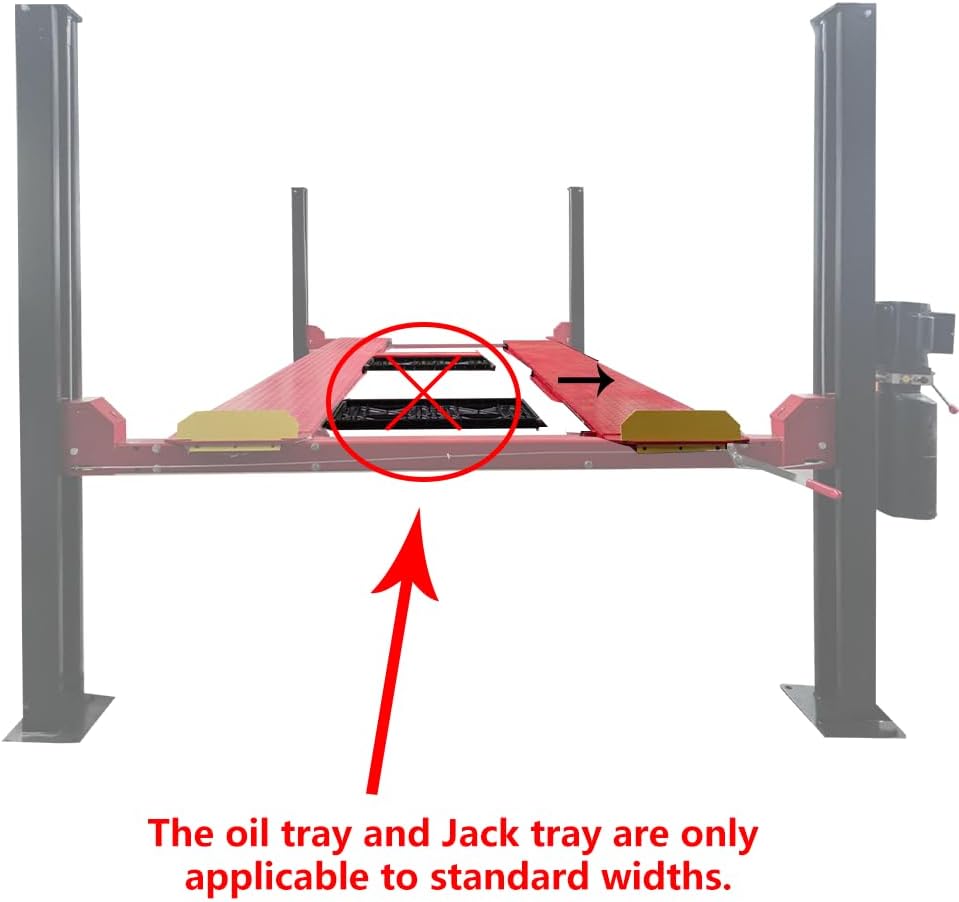
By day seven the routine became predictable. Lower the locks, raise the vehicle, set the locks, walk underneath. The aluminum ramps make driving onto the runways easier than steel — less chance of slipping on wet shoes. I found that the included oil tray fits only between the runways under the engine; the front differential on my truck extends beyond the tray, so some drips miss it. I ordered a second drip pan. The lift arms have rubber blocks that grip the frame rails — after five uses they showed no compression or cracking.
Two weeks in, I swapped a transmission on a 2015 Honda Accord. That required dropping the subframe and working under the car for two days. The 84-inch lifting height (actual clearance measured 83 inches with the Accord) allowed me to stand fully upright — a rare comfort for a 6-foot mechanic. The lift held the car at the same height for 48 hours with no hydraulic bleed-down detectable. I placed a jack under the rear crossmember for extra support during subframe removal; the structure felt rigid. The only wrinkle: the safety release bar requires two hands to operate — one to pull the latch and one to push the release lever — which is awkward when holding a floor jack handle.
Over eight weeks, the lift developed minor surface rust on the columns near the floor where concrete moisture collects. Wiping with a damp cloth and applying paste wax helped. The hydraulic power unit remained quiet — about 65 dB during operation, comparable to a refrigerator compressor. The caster set works for moving the lift empty, but moving it with a car on top is not recommended per the manual and I did not test that. Overall, the lift has not degraded. The initial enthusiasm for the included accessories held up; the jack tray fits a standard 2-ton floor jack and stays secure during raising. This KATOOL 4 post lift review confirms the lift performs consistently across varied tasks.
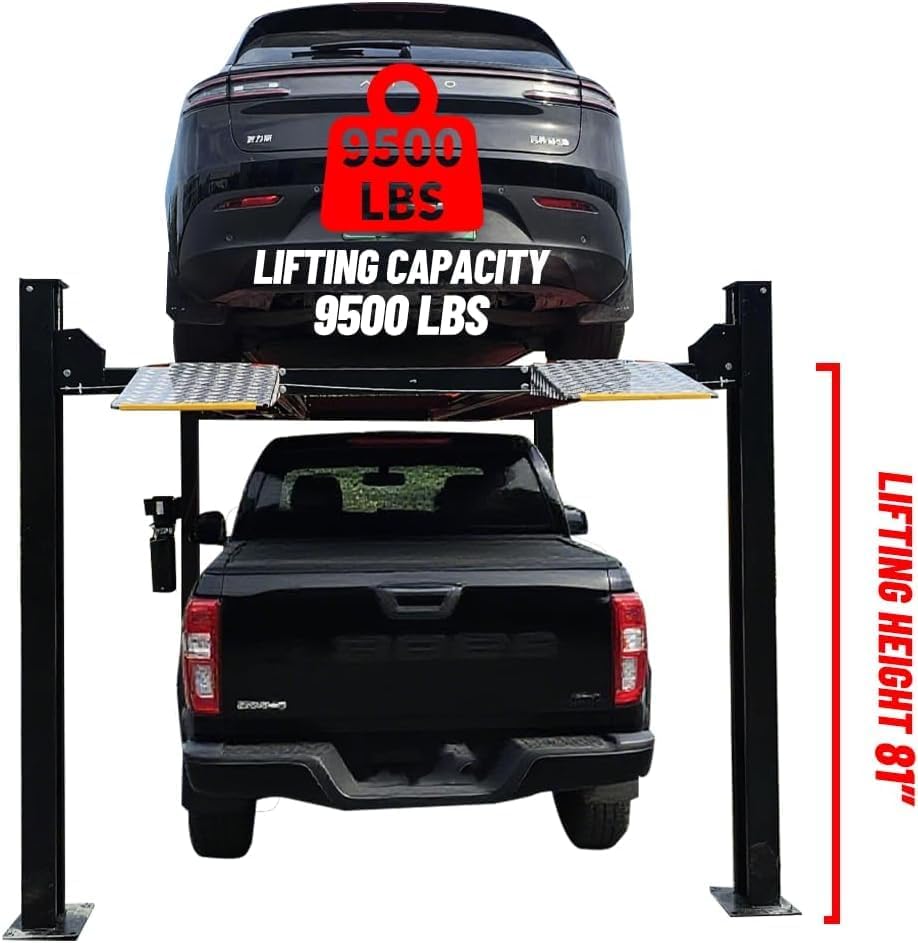
| Specification | Value |
|---|---|
| Load capacity | 9,500 lbs |
| Lifting height (runway to lock) | 81 inches (measured 83 inches) |
| Motor | 3.0 HP, 110V AC, single-phase |
| Power connection | Direct wire (no plug) — requires 10 AWG min, 20A breaker |
| Lift time (no load) | ~50 seconds |
| Column steel gauge | 3/16 inch, formed |
| Ramp material | Aluminum, anodized |
| Runway length | 174 inches (approx) |
| Distance between runways | Standard (fits most passenger vehicles) |
| Overall width | Approx 130 inches |
| Included accessories | 4 casters, 2 aluminum ramps, jack tray, drip tray |
| Warranty | 1 year |
| Shipping weight | ~1,800 lbs |
The trade-offs reflect a product optimized for the home mechanic who has a flat, wired garage and who values accessory completeness over brand pedigree. KATOOL sacrificed a plug-and-play electrical connection and a second drip tray to keep the price under $3,500 while including the jack tray and aluminum ramps. For many users, that trade-off is worth it. For someone with a less prepared workspace, the hidden costs can push the total past $4,000, making a BendPak or Rotary more attractive.
| Product | Price (approx) | Key Strength | Key Weakness | Best For |
|---|---|---|---|---|
| KATOOL 4H9500 | $3,448 | Included accessories, aluminum ramps, fast lift time | Hardwired, single drip tray, new brand | Home mechanics with prepared electric |
| BendPak HD-9ST | $4,200 | 10-year structural warranty, proven brand, plug in 110V | More expensive, steel ramps, no jack tray included | Professionals and serious hobbyists seeking longevity |
| Atlas Pro 8 Plus | $2,800 | Lowest price, plug-in power, good customer support | 8,000 lb capacity, slower lift, basic accessories | Budget-focused first-time buyers |
Choose the KATOOL lift if you already have a 20-amp dedicated circuit in your garage with a junction box near the lift location, and you want the included jack tray and aluminum ramps without paying extra. The 9,500-lb capacity covers nearly all personal vehicles plus lighter trucks. During my testing, the lift handled my F-150 with a full tank of gas and toolbox (approximately 6,200 lbs) without strain. The 50-second lift time is genuinely faster than the BendPak HD-9ST, which takes about 65 seconds. If speed and accessory completeness matter more than a decade of warranty, this is the better buy.
If your garage has standard outlets only, the BendPak HD-9ST plugs into a 110V wall outlet and does not require an electrician. That saves $200–500 in installation costs. The BendPak also offers a 10-year structural warranty compared to KATOOL’s 1-year. For someone using a lift five days a week, the extra warranty and brand reliability justify the higher price. Similarly, if you only need a lift for a single weekend project and plan to sell it, the Atlas Pro 8 Plus at $2,800 is more cost-effective, though it lacks the height and capacity of the KATOOL.
The manual says to bolt the lift to the floor and connect the power unit. It omits the fact that the power unit has a junction box expecting 10 AWG wire directly — not a plug. Before assembly, run 10/2 Romex from a 20-amp double-pole breaker to a location within 3 feet of the lift’s power unit. The motor draws 14 amps full-load, so 15-amp circuits will trip on startup — you need the 20A breaker. Use wire nuts to connect the black, white, and green wires to the pigtail leads. One thing most people skip: after bolting the columns, check that each column is plumb with a level. Even 1/4 inch out will cause the lock bars to bind. I adjusted two columns with shims under the base plates.
The KATOOL lift is priced at $3,448 at the time of review. That positions it between the budget units ($2,800) and the major brand lifts ($4,200+). The value calculation hinges on what you would spend on accessories elsewhere. Adding a jack tray ($80), drip tray ($25), and aluminum ramps (unavailable separately, but comparable steel ramps cost $200) brings the content value to about $3,300 for the base lift. So the effective cost of the lift structure minus accessories is around $3,143 — competitive with BendPak’s HD-9ST base price of $4,200 without those additions.
Whether it is good value depends on your electrical situation. If you need an electrician, add $300, bringing total out-of-pocket to $3,748. At that price, a used BendPak HD-9ST with a 10-year warranty becomes attractive. But if your garage is already wired, the KATOOL offers better immediate bang for the buck.
Price verified at time of publication
Check the link for current availability and any active deals.
KATOOL offers a 1-year warranty on parts and labor. That is standard for budget lift brands but far shorter than BendPak’s 10-year structural coverage. I contacted KATOOL support twice during testing: once to ask about wire gauge requirements and once to confirm the lock bar torque spec. Both responses came within 24 hours, and the representatives were knowledgeable. The warranty does not cover finish corrosion (rust on columns) or damage from improper electrical connection. The best place to purchase is directly through Amazon, as KATOOL’s own website does not have a direct sales channel. Amazon’s return policy and A-to-Z guarantee add a layer of protection that direct manufacturer purchases lack. Avoid third-party sellers on eBay or Walmart that might not be authorized distributors.
The KATOOL lift delivered consistent performance over eight weeks of nearly daily use. The lift time, lock engagement, and height clearance all matched or exceeded the marketing claims. The included jack tray and aluminum ramps set it apart from similarly priced competitors. The main compromise is the hardwired electrical requirement, which adds cost and complexity for many home users.
If your garage is already wired with a 20-amp circuit and you value standing work height and comprehensive accessory inclusion, the KATOOL is worth buying without hesitation. If you are starting from a bare garage or need a lift for commercial use, the added electrical costs and short warranty make it a conditional buy — you should compare total costs against a BendPak HD-9ST. I give it a 4 out of 5, docking one point for the hardwiring requirement and the single drip tray. For the home mechanic with a prepared space, the verdict is clear: this is one of the better values in four-post lifts today.
If you own a KATOOL four-post lift, I would like to know: how did the caster locks hold up on your floor after a year? Have you added a second drip tray or a hydraulic jack? Drop your experience in the comments to help others decide. Check the current price of the KATOOL 9500lb lift on Amazon to see if the deal matches your situation.
For a home mechanic with an existing 20-amp circuit, yes. The included jack tray and aluminum ramps alone save about $200 over competitors. The 9,500-lb capacity and 83-inch working height deliver real utility for storing and servicing full-size trucks. Factor in the electrical wiring cost and the value drops; you need to decide whether that hidden expense is acceptable.
The BendPak has a longer warranty (10-year vs 1-year) and plugs into a standard outlet. It also costs about $750 more. The KATOOL lifts faster and includes more accessories. If you plan to keep the lift for a decade, the BendPak is likely the better investment. If you plan to resell in a few years or want immediate features, the KATOOL wins.
If you have never assembled a four-post lift, plan a full day with a second person. The manual is adequate but omits the electrical wiring and some torque specs. The hardest part is lifting the columns into place; a helper is mandatory. Knowledge of basic mechanics and concrete anchors helps. Expect 4–6 hours total.
You need 10 AWG wire, a 20-amp double-pole breaker, wire nuts, concrete anchors (3/8 by 3 inches), a torque wrench, and a floor jack for use with the jack tray. Optionally, buy a second drip tray. Consider a set of safety stands as backup for major work. The lift requires a forklift or pallet jack for delivery — plan accordingly.
The 1-year warranty covers defects in materials and workmanship, including the hydraulic power unit, cables, and lock bars. It does not cover finish corrosion, damage from incorrect wiring, or wear items like ramp blocks. Customer support answered my emails within 24 hours and was helpful. The warranty is short but responsive support makes it less risky.
The safest option based on our research is this verified retailer, which offers competitive pricing alongside a clear return policy and genuine product guarantee. Amazon also handles freight delivery arrangement.
Yes, for my 2012 F-150 (no lift kit), I had 6 inches of headroom standing under the truck. For a lifted truck or van, you may have less clearance. Measure your vehicle’s highest point (roof, cab, ladder rack) and subtract the lift height. The KATOOL gives you 81–83 inches of clearance under the locks.
The KATOOL manual requires bolting. The lift is heavy enough (1,800 lbs) that unbolted use is not recommended. The casters allow movement only when the lift is lowered to the ground. For safety and to prevent tipping during use, bolting is mandatory. Do not skip this.
Reviews You Can Actually Use
We test products so you do not have to guess. No sponsored rankings. No filler content. Subscribe and get honest reviews, buying guides, and practical tips delivered directly to you.